
Social Media Calendar Template (2026): Copy-Ready Columns for Google Sheets and Excel

Most calendar templates fail for the same reason: they track too many columns nobody fills in, and none of the columns that actually decide whether a post ships. This page gives you a lean, copy-ready structure, the weekly routine that keeps it running, and a clear picture of what you can automate in 2026 versus what still needs a human hand.
TL;DR
- Copy the seven-column table below into Google Sheets or Excel. The columns are Date, Platform, Format, Hook or caption angle, Asset, Status, and Link. That is the whole template.
- Run it on a weekly batch: one planning block, one creation block, one scheduling block. Batching by task beats working post by post.
- Use a simple content mix so you are not all promotion. A common starting split is roughly four in five posts that help or entertain, one in five that sells.
- In 2026 you can schedule natively on most platforms (Instagram public accounts, Facebook and Instagram via Meta Business Suite, LinkedIn, TikTok, X, YouTube, and Google Business Profile). A cross-platform tool is worth it mainly for one queue plus analytics.
- Prefer to skip the spreadsheet? Build the same structure with our content calendar generator.
Jump to: The template . What each column tracks . Weekly workflow . Content mix . What you can automate in 2026 . Cadence starting points . Hashtags . Adapt it . Mistakes . FAQ
The content calendar template
Here is the core template. Copy the header row and the example week straight into a spreadsheet, then clear the sample rows and start filling your own.
That is deliberately small. Seven columns is enough to plan, assign, and ship. Add columns only when you keep needing the same missing field (owner, campaign, or budget are the usual next three).
Copy the spreadsheet version
The table above pastes cleanly into Google Sheets or Excel. Copy the header and rows, then add a data-validation dropdown on the Status column so it stays consistent.
Jump to the templateGenerate one automatically
Want it prefilled around your niche and posting frequency? Our free generator builds the same structure with sample ideas you can edit.
Open the calendar generatorWhat each column tracks
Each column earns its place by answering one question:
- Date: When it publishes, not when you make it. Keep making and publishing separate in your head.
- Platform: One row per platform, even for the same idea, because the format and caption change per platform.
- Format: Reel, carousel, thread, text, link, long video, story. Format drives how much production time you need to block.
- Hook or caption angle: The single most useful column. Write the angle, not the finished caption. If you cannot state the hook in one line, the post is not ready.
- Asset: The exact file name or folder so anyone on the team can find it. "TBD" here means the post is not shippable yet.
- Status: A short pipeline. Idea, Drafting, Ready, Scheduled, Published. This is what you scan on a busy day to see what is at risk.
- Link: The destination plus a UTM tag so you can attribute traffic later. Even a simple naming convention beats guessing in analytics.
For deeper background on the planning side, see our social media content calendar guide and the free editorial calendar template if you also publish long-form content.
How to run the calendar each week
The template only works if you run it on a rhythm. Batch by task, not by post, so you are not switching between writing, designing, and scheduling all day.
- Plan block (about 60 to 90 minutes). Fill the coming week or two with dates, platforms, formats, and one-line hooks. Leave a few slots empty on purpose for anything timely.
- Create block. Produce assets in like-with-like batches. Shoot several short videos in one sitting, then design several graphics, then write captions in one pass. Move each row to Ready as its asset lands.
- Schedule block. Load everything that is Ready into your scheduler (native or third-party), set the times, and flip rows to Scheduled. On publish day the calendar should mostly run itself.
- Review block. Once a week, look at what actually shipped versus planned, and note what performed so next week's hooks get sharper.
This is the real unlock over a fancier template: consistency comes from the routine, not from more columns. For the wider operating picture, see the social media management workflow.
Create content, post everywhere
Create captions, images, and videos with AI. Schedule to 9 platforms in seconds.
Start your free trial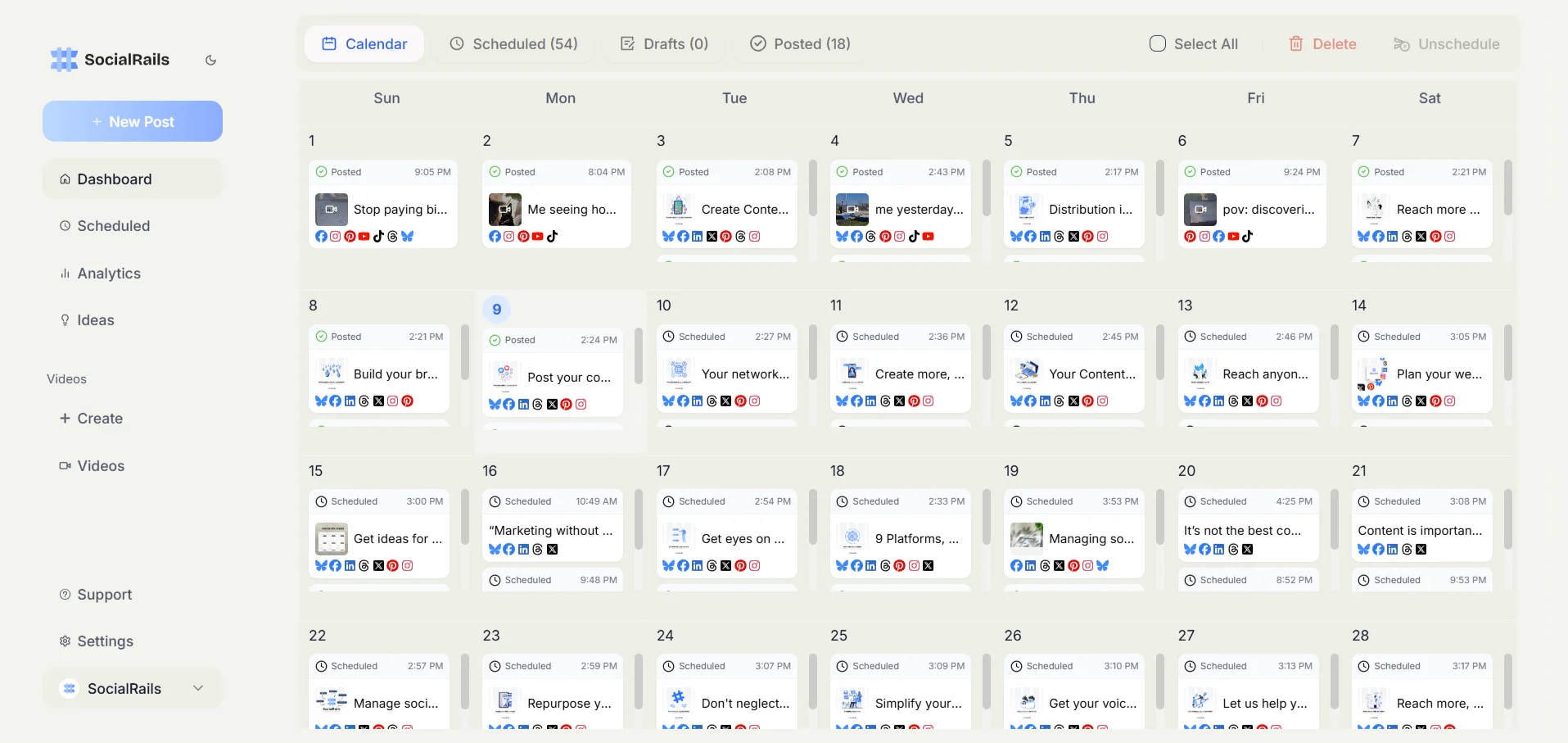
Your content mix
If every post sells, engagement drops and people tune out. A simple starting split keeps the feed worth following:
- Roughly four in five posts help or entertain: how-to content, behind the scenes, opinions, stories, and answers to real questions.
- Roughly one in five posts sells: product, offer, or a direct call to action.
Inside the helpful bucket, rotating a few content pillars (for example educational, story or proof, and lighter or trend-led) keeps ideas flowing without repeating yourself. Treat these as starting ratios to adjust once you see what your audience responds to, not fixed rules.
What you can automate in 2026
Native scheduling has expanded a lot, which changes what a template is even for. Plan everything in the calendar; automate the publishing where the platform supports it.
- Instagram: Native scheduling is available to any public account as of March 2026, directly in the app and through Meta Business Suite. You no longer need a third-party tool just to schedule a feed post or reel.
- Facebook and Instagram together: Meta Business Suite schedules both from one place. Note that Creator Studio was retired in 2024, so any guide pointing you there is out of date.
- LinkedIn: Native post scheduling is built into the composer for both profiles and pages.
- TikTok: The web studio lets you schedule videos in advance.
- X: Scheduling is available from the web composer.
- YouTube: Uploads can be set to publish at a chosen time, with Shorts included.
- Google Business Profile: Native post scheduling arrived in November 2025, useful if local posts are part of your mix.
What is still worth a cross-platform tool: a single queue across accounts, team approvals, and analytics in one view. That is where a scheduler like SocialRails or one of the best social media schedulers earns its keep, and if budget is tight, the Hootsuite alternatives roundup covers cheaper options.
Posting cadence starting points
Use these as starting points to test, not targets to hit no matter what. Fewer strong posts beat more filler.
- Instagram: A few feed posts or reels a week, plus stories when you have something to show.
- LinkedIn: A few posts a week; long articles far less often.
- TikTok: Higher frequency suits the platform if you can keep quality up.
- X: Comfortable with more posts a day since the feed moves fast.
- Facebook and YouTube: Lower frequency, higher effort per post.
For timing rather than frequency, our data-backed guides on the best time to post on Instagram and the best time to post on LinkedIn go platform by platform. Then confirm against your own audience's active hours.
Hashtags in 2026
Hashtag advice has changed, so ignore older "use 30 on Instagram" tips. Instagram now favors a small set of genuinely relevant tags; piling on dozens no longer helps reach and can read as spam. Sensible starting points:
- Instagram: About three to five relevant hashtags tied to the post's topic.
- X: One or two at most.
- LinkedIn: Three to five focused, professional tags.
- TikTok: A few tags tied to the actual trend or topic, not a generic wall.
If you want help finding tags that fit a post, try our hashtag research tool.
Adapt the template
The same seven columns flex to most situations:
- Solo creator: Drop the Status column to just Ready or Not ready. Speed matters more than pipeline detail.
- Small team: Add an Owner column and use the Status column as your handoff signal.
- Agency or multi-brand: Add a Brand or Client column and one tab per account so nothing bleeds across clients.
- Campaign-heavy months: Add a Campaign column so you can filter every post tied to a launch.
- Seasonal planning: Pre-load recurring dates. Holidays like National Dog Day in August or themed days you know convert are easy wins when they are already on the calendar.
Common calendar mistakes
- Too many columns. If a field is empty three weeks running, delete it.
- Planning the whole month rigidly. Leave open slots for timely posts and trends.
- One caption everywhere. Keep the core idea, but rewrite the hook and format per platform. Identical cross-posts tend to underperform.
- No backup content. Keep a few evergreen posts ready for the week everything slips.
- Ignoring what shipped. The weekly review is where the calendar actually improves. Skip it and you plan blind.
- Overposting. More is not better past a point; see what overposting does.
Template vs scheduling tools
A spreadsheet is a planning surface. A scheduler is a publishing engine. They do different jobs, and the honest comparison is about fit, not a single winner.
Many teams use both: plan in the template, then push the Ready rows into a scheduler. If you want measurable goals attached to the calendar, pair it with SMART goals for social media.
Frequently Asked Questions
How far in advance should I plan my social media content calendar?
Planning one to four weeks ahead works for most teams. Fill in dates, platforms, formats, and one-line hooks, but leave some slots open on purpose so you can react to trends and timely moments. Planning too rigidly for a whole month usually means half of it gets scrapped anyway.
How many posts should I schedule per day on each platform?
Treat frequency as a starting point to test, not a fixed target. Fast-moving feeds like X can handle more posts a day, TikTok rewards higher frequency if quality holds, while Instagram, LinkedIn, Facebook, and YouTube tend to reward fewer, stronger posts. A few strong posts beat a stream of filler.
Should I post the same content across all social media platforms?
Keep the core idea, but adapt the format and hook for each platform. A reel, a LinkedIn text post, and an X thread of the same idea should read differently. Identical cross-posts tend to get less reach because they ignore each platform's format and audience expectations.
What's the best time to post on social media according to this calendar?
There is no single universal time. General windows on weekday mornings and evenings are a fine starting guess, but your own audience data matters more. Our best time to post guides break it down platform by platform, and you should confirm against when your followers are actually active.
How do I maintain consistency during busy periods using this calendar?
Batch by task during a calm week: plan in one block, create assets in like-with-like batches, and schedule everything at once. Keep a few evergreen posts marked Ready so there is always something to publish when a busy week eats your creation time.
Which platforms let me schedule posts natively in 2026?
As of 2026 you can schedule natively on Instagram (public accounts), Facebook and Instagram via Meta Business Suite, LinkedIn, TikTok's web studio, X, YouTube, and Google Business Profile. Creator Studio was retired in 2024, so use Meta Business Suite instead. A cross-platform scheduler is mainly worth it for one shared queue, approvals, and combined analytics.
How many hashtags should I add per platform now?
Older advice to use around 30 hashtags on Instagram is outdated. Instagram now favors a small set of relevant tags, roughly three to five. On X use one or two, on LinkedIn three to five focused tags, and on TikTok a few tied to the actual trend. Relevance matters far more than volume.
Can I customize this social media calendar for my specific industry?
Yes. The seven columns are a base you can extend. Solo creators can simplify the Status column, teams can add an Owner column, and agencies can add a Brand or Client column with one tab per account. Adjust content pillars and posting frequency to fit how your audience behaves.
Related guides and tools
- Social media content calendar guide: the strategy behind the template.
- Free editorial calendar template: for long-form and blog planning.
- Social media management workflow: the full operating routine.
- Best time to post on Instagram and on LinkedIn: timing your slots.
- Content calendar generator and hashtag research tool: free tools to speed things up.
Was this article helpful?
Let us know what you think!