
How to Announce a Rebrand on Social Media: Templates, Examples & Timeline

A rebranding announcement on social media can either generate excitement and growth, or confuse your audience and cost you followers. The difference comes down to preparation, timing, and messaging.
This guide walks you through exactly how to announce a rebrand on social media, with copy-paste templates, a launch timeline, and lessons from real rebrands like Dunkin', Mailchimp, and Twitter/X.
Jump to: Pre-Launch Checklist | Timeline | Templates | Platform Strategies | Examples | FAQ
Pre-Launch Checklist
Before you post anything, every asset, message, and team member needs to be ready. A partial rebrand, where your Instagram shows the new logo but your LinkedIn still has the old one, creates confusion and undermines trust.
2 to 4 weeks before launch:
- New brand assets finalized (logo, colors, fonts, brand guidelines)
- Social media profile pictures created in all required sizes
- Cover photos and banners designed for every platform
- Updated bio and description copy written for each platform
- Announcement posts drafted and reviewed
- Content calendar updated with post-launch content
- FAQ document prepared for customer service
- Internal team briefed on messaging and timeline
- Email announcement drafted for subscribers
- Website updated (or scheduled to update on launch day)
- If changing your handle: check username availability on all platforms
Day before launch:
- All new assets uploaded to each platform (saved as drafts, not published)
- Scheduled posts queued
- Customer service team briefed and ready
- Monitoring tools set up to track mentions and sentiment
What to Update Across Platforms
The golden rule: Update everything at once. If someone visits your Instagram and sees a new logo, then clicks through to your LinkedIn and sees the old one, you've immediately created doubt.
When should you update your social media profiles during a rebrand?
Rebrand Announcement Timeline
There are two main approaches to announcing a rebrand. Choose based on your brand's size, audience, and how dramatic the change is.
Option 1: Big Reveal (Surprise Launch)
Best for: Smaller brands, subtle refreshes, or when you want maximum impact in a single moment.
Day 0, Launch Day:
- Update all profiles simultaneously (early morning, before peak hours)
- Publish announcement posts across all platforms
- Pin or highlight the announcement post
- Post Stories and Reels showing the new brand
- Send email announcement to subscribers
- Issue press release (if applicable)
Days 1 to 7:
- Behind-the-scenes content about the rebrand process
- "Why we rebranded" explainer post or video
- Team introduction posts with new branding
- Actively engage with every comment and question
- Monitor sentiment and address concerns quickly
Option 2: Teaser Campaign (Build Anticipation)
Best for: Larger brands, dramatic name changes, or when you want to generate buzz before the reveal.
2 weeks before launch:
- Post cryptic "something's coming" teasers
- Start a countdown (use Instagram countdown stickers)
- Drop subtle hints without revealing the new brand
1 week before:
- Reveal more specific hints (color peeks, shape teasers)
- Employee takeover content building excitement
- Countdown intensifies
Day 0, Reveal Day:
- Full brand reveal across all platforms simultaneously
- Explanation content: the story behind the rebrand
- Launch celebration content (team photos, office reactions)
Week 1 after launch:
- Deep-dive content about the new brand identity
- FAQ posts addressing common questions
- Customer feedback and reaction content
Which Approach Should You Choose?
Announcement Post Templates
These templates work as starting points. Customize them with your specific brand details, voice, and story.
Template 1: The Standard Announcement
Works on: All platforms. Best for straightforward rebrands.
We have some exciting news...
[Old Name] is now [New Name].
After [X years] of [brief history, e.g., "helping small businesses grow their social media presence"], we're evolving. Our new name and look reflect [specific reason, e.g., "our expanded focus on full-stack marketing tools"].
What's changing: → Fresh new look and visual identity → New name: [New Name] → New website: [URL]
What's NOT changing: → Our commitment to [core value] → The team you know and trust → Our mission to [mission statement]
We're excited for this next chapter, and grateful you're part of it.
Link in bio for the full story.
#Rebrand #NewLook #[NewName]
Template 2: The Storytelling Approach
Works on: LinkedIn, Instagram carousels, Facebook. Best for brands with a strong origin story.
[X] years ago, we started with a simple idea: [original mission].
That idea has grown into something bigger than we imagined.
We've gone from [early state, e.g., "a two-person team in a garage"] to [current state, e.g., "a team of 50 serving 10,000+ customers"].
And our brand needed to catch up.
Today, we're proud to introduce [New Name].
Our new identity reflects who we've become: → [Evolution point 1, e.g., "A platform, not just a tool"] → [Evolution point 2, e.g., "Built for teams, not just solo creators"] → [Evolution point 3, e.g., "Global reach, local roots"]
Same team. Same values. A new chapter.
Welcome to [New Name]. [Link to full story]
Template 3: The Short and Direct Announcement
Works on: X/Twitter, quick Stories. Best for minimal, confident brands.
New name. Same mission.
[Old Name] → [New Name]
Here's why: [one-sentence reason]
[Link to learn more]
Template 4: The "New Logo" Announcement
Works on: Instagram, Facebook, LinkedIn. Best when you're refreshing your visual identity but keeping the name.
Same [Company Name]. Fresh new look.
We've updated our logo and visual identity to better reflect where we're headed.
Why the change? [1 to 2 sentences explaining the reason, e.g., "Our original logo was designed when we were a one-product company. We've grown into a full platform, and our brand needed to reflect that."]
What you'll notice: → New logo across all our platforms → Updated color palette and design → Refreshed website experience
What hasn't changed: → Everything you love about [Company Name] → Our team, our product, our commitment to you
We'd love to hear what you think.
Template 5: The Employee/Team Announcement
Works on: LinkedIn, Instagram. Best for humanizing the rebrand.
I've been keeping a secret for the past [X] months.
Today, I finally get to share it: [Company] has a new look.
As [your role], I've watched this rebrand come together from the first brainstorm to this very post. Here's what it means to me:
[Personal perspective on why the rebrand matters, 2 to 3 sentences]
The name may be [new/the same], but the heart of what we do hasn't changed.
I'm proud of this team and excited about what's ahead.
Welcome to the new [Company Name].
Platform-Specific Strategies
Each social media platform has different norms, formats, and audience expectations. Here's how to tailor your rebranding announcement for each one.
Instagram Rebrand Strategy
Instagram is visual-first, making it one of the most impactful platforms for a rebrand announcement.
Profile updates:
- New profile picture (make sure it's readable at small sizes, since simple icons work better than wordmarks)
- Updated bio with new brand name and positioning
- Refresh all Highlight covers to match new branding
- Update link in bio to point to an announcement page or new website
Content to post:
- Announcement carousel: Walk followers through the rebrand story in 5 to 8 slides: old brand → why the change → new brand reveal → what stays the same → what's next
- Behind-the-scenes Reel: Show the design process, team reactions, or a timelapse of the brand evolution
- Before/after Stories: Use the visual contrast to make the change tangible
- Q&A sticker in Stories: Let followers ask questions about the rebrand
- Countdown sticker (for teaser campaigns): Build anticipation before the reveal
Instagram-specific tips:
- Post the announcement during peak engagement hours for your audience
- Use relevant hashtags: mix branded + community hashtags
- Respond to every comment in the first 24 hours to boost the post algorithmically
LinkedIn Rebrand Strategy
LinkedIn is where you announce to your professional network: partners, clients, industry peers, and potential hires.
Profile updates:
- New company logo as profile picture
- Updated banner image
- Revised "About" section with refreshed positioning
- Update all company details (name, website URL, specialties)
Content to post:
- Company page announcement: Professional tone, focus on the strategic reason behind the rebrand
- Founder/CEO personal post: These often outperform company page posts on LinkedIn. Write from a personal perspective about why this rebrand matters
- "Why we rebranded" article: LinkedIn Articles give you long-form space to tell the full story
- Employee-shared content: Encourage team members to share the announcement from their personal profiles with their own perspectives
LinkedIn-specific tips:
- Founder posts about company milestones typically get high engagement on LinkedIn
- Tag relevant people (design agency, team leads) to expand reach
- Post the company announcement and the personal founder post on the same day but stagger by a few hours
X (Twitter) Rebrand Strategy
X is fast-paced and conversational. Your announcement needs to be concise and engage-ready.
Profile updates:
- New profile picture
- Updated banner
- Bio refresh with new positioning
- Pin the announcement tweet
Content to post:
- Announcement tweet: Keep it short and punchy. Link to a longer explanation
- Thread: If the story is worth telling in detail, use a thread: tweet 1 = the news, tweets 2 to 5 = the story, final tweet = CTA
- Engage with replies actively: X rewards conversation. Reply to everyone in the first few hours
- Follow-up tweets over the next week: Different angles on the rebrand (the design process, team reactions, customer feedback)
X-specific tips:
- Announce early in the day so you can engage with replies all day
- Use the new brand name in your display name immediately
- If you're changing your handle, tweet from the old handle first so followers know what happened
Facebook Rebrand Strategy
Facebook is still relevant for community-driven brands, local businesses, and B2C brands with active groups.
Profile updates:
- New profile picture and cover photo
- About section refresh
- Page name change (if applicable, Facebook requires approval for name changes, so apply early)
- Update all CTA buttons and links
Content to post:
- Announcement post with a strong visual (video or designed graphic)
- Photo album of new brand assets, office signage, team photos with new branding
- Facebook Live or video explaining the rebrand: live Q&A works well here
- Milestone post marking the rebrand as a company milestone
YouTube Rebrand Strategy
If you have a YouTube channel, updating it is essential, since your channel art is often the first thing returning visitors notice.
Profile updates:
- New channel art / banner
- Updated profile picture
- Refresh "About" section
- Update channel trailer
Content to post:
- Rebrand announcement video: This can be a short (1 to 2 min) video explaining the change, or a longer behind-the-scenes documentary
- Community post: Use YouTube's community tab to announce the rebrand with an image
- Updated channel trailer: Reflect the new brand identity
TikTok Rebrand Strategy
TikTok favors authentic, unpolished content. Your rebrand announcement should feel natural, not corporate.
Profile updates:
- New profile picture
- Updated bio
- Link updated
Content to post:
- "Get ready with me" style rebrand reveal: Show the before and after in a casual, authentic way
- Trending audio + rebrand reveal: Use a popular sound that fits the "transformation" theme
- Team reaction video: Film your team seeing the new brand for the first time
- Behind-the-scenes process: Show the design evolution in a fast-paced edit
What to Communicate (and What Not to Say)
The "why" behind your rebrand matters more than the "what." People don't just want to see the new logo; they want to understand the reason for the change.
Good Reasons to Share
- • "We've outgrown our original identity"
- • "Our services have expanded beyond [original scope]"
- • "We're entering new markets"
- • "Our brand didn't reflect our values anymore"
- • "We merged with / acquired [company]"
- • "We wanted a name that works globally"
Avoid Saying
- • "We needed to fix our reputation"
- • "Our old brand was ugly / outdated"
- • Nothing at all (no explanation)
- • "Everyone else is rebranding"
- • "Our investors wanted a change"
- • Overly corporate jargon with no real substance
Address Customer Concerns Proactively
Don't wait for people to ask. Address these questions in your announcement content or in a pinned FAQ:
- Is this still the same company? Yes, same team, same product, same mission.
- Will my account / subscription still work? Yes, nothing changes on your end.
- Are prices changing? [Be honest: if yes, explain separately. If no, say so clearly.]
- Why did you change the name? [One clear sentence.]
- Where can I learn more? [Link to a dedicated page.]
Handling Feedback After the Announcement
Every rebrand generates a mix of reactions. Having response templates ready means your team can engage quickly and consistently.
For Positive Reactions
Thank you! We're excited too. This new chapter reflects [brief reason] and we can't wait to keep building for you.
For Questions or Curiosity
Great question! [Answer their specific question]. We've put together more info here: [link to FAQ or blog post]
For Negative Reactions
We hear you. Change can feel unexpected. [Address their specific concern]. Our commitment to [core value] hasn't changed. Happy to chat more if you want to DM us.
For "I Liked the Old Brand"
We appreciate you being with us through this journey! The old brand served us well, but as we've grown, we wanted our look to better reflect who we are today. Same team, same values, fresh look.
Tip: Don't delete negative comments unless they're abusive. Engaging with respectful criticism publicly shows confidence and builds trust.
Real Rebrand Examples
Dunkin' (formerly Dunkin' Donuts), 2019
Dunkin' Donuts dropped "Donuts" from its name to reflect its broader menu (coffee, sandwiches, beverages) without losing its identity.
What they did well:
- Kept the iconic pink-and-orange color scheme, so the brand was still instantly recognizable
- Messaging focused on what wasn't changing: "We're still the same Dunkin' you love"
- Gradual signage rollout gave people time to adjust
- Social media posts were playful and self-aware: leaning into the name change with humor
Key takeaway: If you're changing your name, keep visual elements people recognize. Don't change everything at once.
Mailchimp: 2018 Brand Refresh
Mailchimp didn't change its name but completely overhauled its visual identity: new illustrations, typography, color palette, and brand voice.
What they did well:
- Published a dedicated brand guide website (mailchimp.com/design) explaining the new identity in depth
- The refresh told a clear evolution story: "We've grown from an email tool to a full marketing platform"
- Rolled out consistently across all touchpoints: website, app, social media, physical merch
- Content explained the thinking behind every design decision, making it feel intentional rather than arbitrary
Key takeaway: Even if you're not changing your name, a brand refresh deserves a full announcement. Document your thinking and share it publicly.
Twitter to X: 2023
Twitter's rebrand to X is a cautionary example. The execution was abrupt, the reasoning was unclear to most users, and the brand equity of "Twitter" (and the iconic bird logo) was abandoned overnight.
What went wrong:
- No advance communication or teaser campaign
- The "why" was vague: most users didn't understand the vision for "X" as an "everything app"
- The brand change happened before the product changed, creating a disconnect
- Years of built-in language ("tweet," "retweet") was suddenly out of date with no clear replacement
Key takeaway: Your new brand needs to be connected to something real: a product evolution, a new direction, a clear vision. Changing the name without changing the experience creates confusion.
Staples: 2023 Brand Refresh
Staples refreshed its visual identity with a modern logo while keeping the iconic staple shape that people recognized.
What they did well:
- Maintained brand recognition by evolving the staple icon rather than replacing it
- Clear connection between old and new: anyone could see the evolution
- Announced on social media with clean before/after visuals
Key takeaway: You don't always need a dramatic change. Evolving a recognizable element can feel fresh without feeling unfamiliar.
Common Rebrand Mistakes (and How to Avoid Them)
1. Inconsistent rollout across platforms Your Instagram shows the new logo, but LinkedIn still has the old one. This instantly undermines trust. Fix: Use the checklist above and update all platforms within the same hour.
2. No explanation for the change People see a new name or logo and have no idea why. Fix: Always share the reason. Even a single sentence ("We've grown beyond email, and our name needed to reflect that") goes a long way.
3. Ignoring negative feedback Deleting critical comments or going silent when people push back. Fix: Acknowledge concerns publicly and respond with empathy. Most pushback fades within a week if you engage honestly.
4. Changing everything at once New name, new logo, new colors, new voice, new website, new product, all on the same day. Fix: Keep at least one recognizable element (name, color, icon) so people can connect old and new.
5. Forgetting to update secondary touchpoints You update social media but forget email signatures, invoice templates, third-party listings, Google Business Profile, or directory listings. Fix: Create a comprehensive list of everywhere your brand appears and check them all.
6. No internal alignment Your customer service team finds out about the rebrand from social media, just like everyone else. Fix: Brief your entire team before the public announcement. Give them talking points and FAQ answers.
7. Not considering SEO implications If you're changing your domain, company name, or URL structure, you risk losing search rankings. Fix: Set up 301 redirects from old URLs to new ones. Update your Google Business Profile. Submit updated sitemaps. Monitor Search Console for crawl errors after launch.
Measuring Rebrand Success on Social Media
After the announcement, track these metrics to understand how your audience is responding:
First 48 hours:
- Engagement rate on announcement posts (likes, comments, shares vs. impressions)
- Sentiment of comments (positive, neutral, negative)
- Follower count changes (gains or losses)
- Direct messages and questions received
First 2 weeks:
- Brand mention volume (are people talking about you?)
- Follower retention rate
- Website traffic from social media
- Email unsubscribe rate after announcement
First 3 months:
- Overall engagement rate compared to pre-rebrand baseline
- New follower growth rate
- Brand search volume (check Google Trends for your brand name)
- Customer feedback and satisfaction scores
Don't panic if you see a small dip in followers or engagement in the first week; that's normal. What matters is the trend over 4 to 8 weeks.
Post-Rebrand Content Calendar
After the announcement day, keep the momentum going with a planned content sequence:
Rebrand Announcement Checklist (Summary)
Use this as a final check before you hit publish:
- All new brand assets finalized and approved
- Social profiles updated on all platforms (simultaneously)
- Announcement posts drafted, reviewed, and scheduled
- FAQ document prepared for customer service team
- Internal team fully briefed
- Email announcement ready to send
- Website updated or scheduled to update
- 301 redirects in place (if changing URLs/domain)
- Google Business Profile updated
- Monitoring tools ready for sentiment tracking
- Response templates prepared for positive, negative, and neutral feedback
- Post-launch content calendar planned for the next 30 days
Create content, post everywhere
Create captions, images, and videos with AI. Schedule to 9 platforms in seconds.
Start your free trial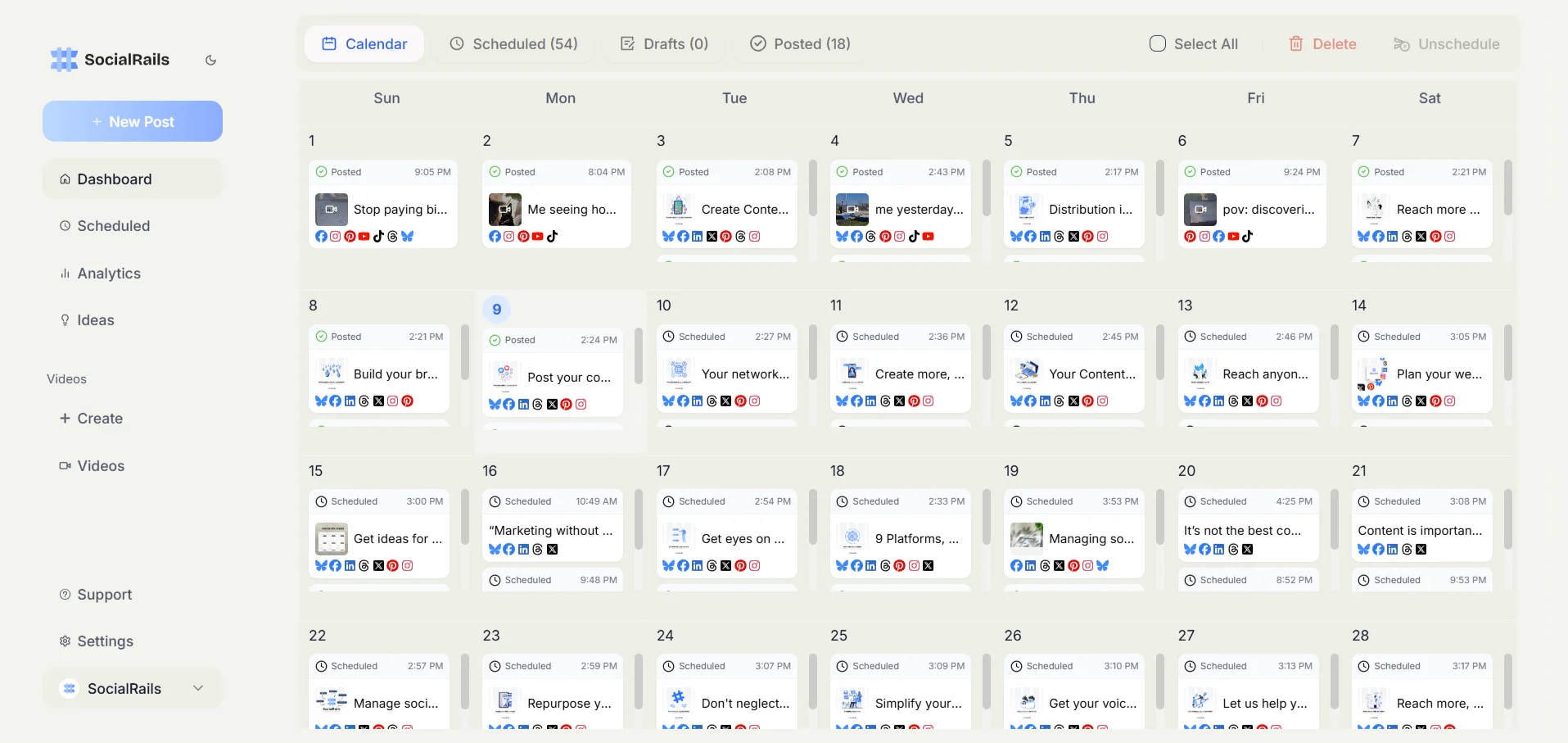
FAQ
How do I announce a rebrand on social media?
Should I change my social media handles during a rebrand?
How far in advance should I plan a social media rebrand?
What should a rebrand announcement post include?
How do I handle negative reactions to a rebrand?
Should I tease a rebrand before announcing it?
What's the best day and time to announce a rebrand on social media?
Do I need to update my social media profiles all at once?
Related Resources
Was this article helpful?
Let us know what you think!