
Best Apps to Schedule Instagram Posts in 2026 (Free and Paid, Verified Pricing)

TL;DR: Best Instagram Scheduling Apps
The single most important change for 2026: you probably do not need a paid app to schedule Instagram posts anymore. Since March 2026, any public Instagram account can schedule feed posts, carousels, and Reels natively in the app, up to 75 days ahead, 25 per day, for free. Stories are the exception and are not covered by native scheduling.
Paid apps still earn their price for four specific reasons: bulk uploading, cross-platform posting, real analytics, and team approval workflows. If none of those apply to you, start free.
Quick picks:
- Free, single account: Instagram native scheduling or Meta Business Suite
- Best overall paid value: Pallyy or Metricool
- Best multi-platform: Buffer or Metricool
- Best visual grid planning: Later or Planoly
- Agencies and teams: Hootsuite or Sprout Social
Jump to: Do you need a paid app? - Pricing comparison - The free baseline - Paid apps worth paying for - Auto-publish vs reminder - How to choose - FAQ
Create content, post everywhere
Create captions, images, and videos with AI. Schedule to 9 platforms in seconds.
Start your free trial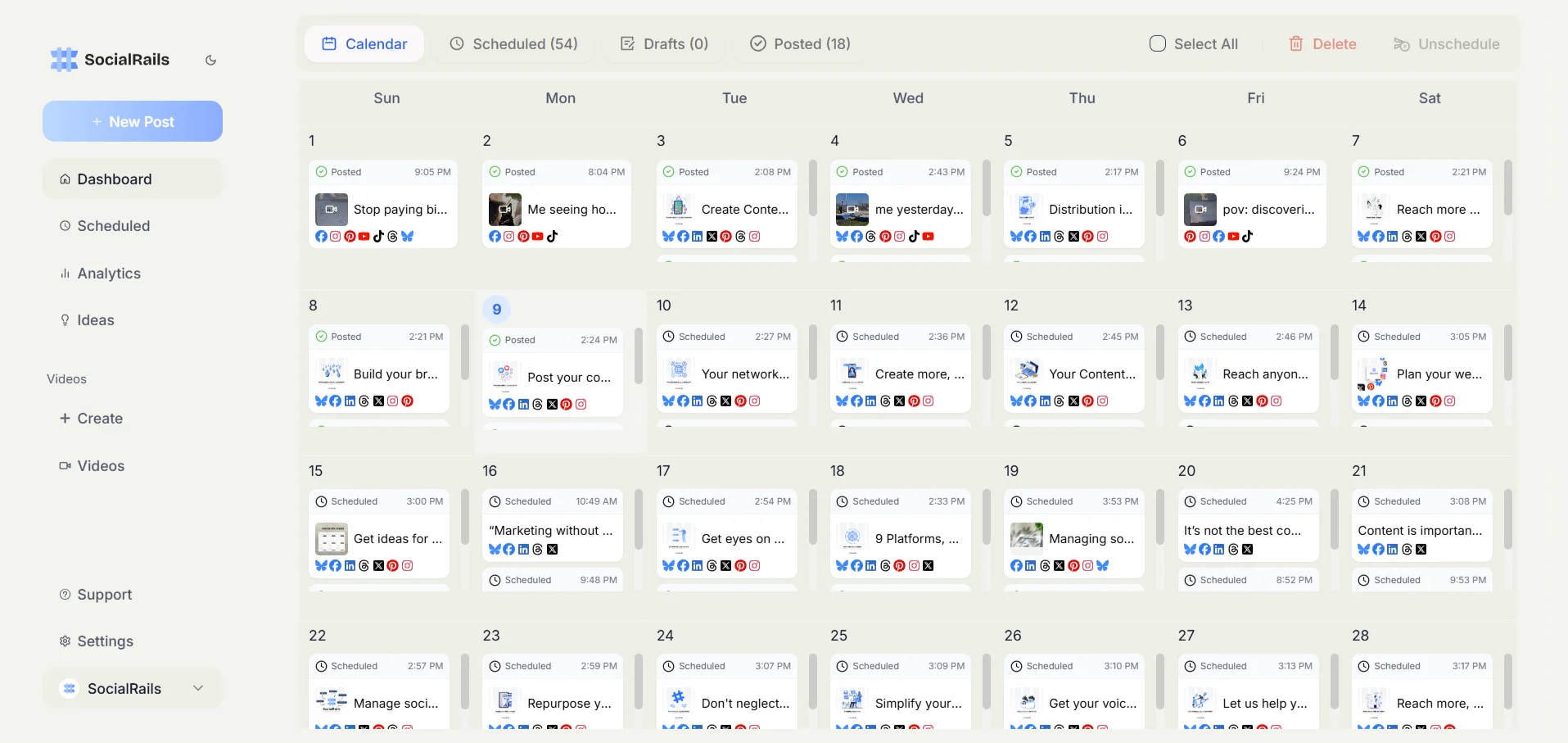
Do You Even Need a Paid App?
Most "best Instagram scheduler" lists skip the honest part, so here it is. As of March 2026, Instagram opened native in-app scheduling to every public account. Before that it was limited to professional accounts through Meta Business Suite. Now the basic job of "line up my posts in advance" is free and built in.
Native in-app scheduling covers:
- Feed photos and videos
- Carousels
- Reels
- Up to 75 days in advance, up to 25 scheduled posts per day
- True auto-publishing, no reminder, no notification step
What it does not cover:
- Stories (still no native scheduling, use Meta Business Suite or a Story-specific tool)
- Bulk CSV or spreadsheet uploads
- Posting to TikTok, LinkedIn, Facebook, Pinterest, or X at the same time
- Deep analytics, competitor tracking, or reporting
- Team roles, drafts, and approval workflows
So the honest test is simple. If you run one Instagram account, post a few times a week, and do not need Stories automation or cross-platform posting, the free native scheduler or Meta Business Suite is genuinely enough. A paid app is worth it once you are batching a month of content at once, posting to several platforms, or working with a team or clients.
For the free Stories workaround specifically, see our guide on how to schedule Instagram Stories, and for Reels see how to schedule Instagram Reels.
Pricing Comparison (July 2026)
Every price below was checked against each vendor's public pricing page in July 2026. Monthly rates are shown. Most vendors discount roughly 15 to 25 percent on annual billing, noted where relevant. Where a price is not cleanly published or varies by channel count, it is flagged.
*Meta Business Suite auto-publishes standard image and video Stories but strips interactive stickers such as polls and question boxes. Reminder = the tool pings you to post manually rather than publishing automatically. See why below.
The Free Baseline: Native Scheduling and Meta Business Suite
Start here before you pay for anything.
Instagram native in-app scheduling
Price: Free. What it does: Schedule feed posts, carousels, and Reels directly in the Instagram app. Open the composer, create your post, then on the final screen open Advanced settings and toggle Schedule this post. Pick a date and time up to 75 days out. Limits: No Stories, no bulk upload, no cross-platform, basic insights only. Your account must be public for the option to appear. Best for: Anyone running a single account who just wants posts queued ahead of time.
Meta Business Suite
Price: Free (unlimited posts). What it does: Meta's own desktop and mobile tool for Instagram and Facebook. It auto-publishes feed posts, Reels, and standard Stories, and it can cross-post to a linked Facebook Page in one step. It includes a content calendar and basic insights. The one caveat: it auto-publishes standard image and video Stories, but interactive Story stickers (polls, questions, link stickers) are stripped or fall back to a reminder because of API limits. Best for: Free scheduling when you also manage a Facebook Page, or when you need free Stories automation.
Note: Meta Creator Studio was retired in 2024, and its scheduling moved into Meta Business Suite. If an older guide tells you to use Creator Studio, it is out of date.
The Paid Apps Worth Paying For
These are the tools that add something the free options do not: bulk uploading, multi-platform posting, deeper analytics, or team workflows. Pricing verified July 2026.
Pallyy: best value for creators
Pricing: Free plan (limited). Starter $15/mo (1 social set, 20 posts/mo), Pro $25/mo (unlimited posts), Agency $99/mo, Scale $199/mo. 14-day trial on paid plans. Why it stands out: a genuinely good visual grid planner, full auto-posting for feed, Stories, and Reels, plus a social inbox and link-in-bio, at a price well below the legacy players. For a solo creator who wants Stories automation and a grid preview, Pallyy is the sweet spot. Watch for: it is a smaller company with fewer integrations than Hootsuite or Sprout.
Planoly: best for grid aesthetics
Pricing: Free plan (limited). Starter $16/mo, Pro $43/mo. Add-on users and social sets billed separately on each tier. Annual billing saves roughly 15 percent. Why it stands out: one of the cleanest visual grid planners, purpose-built for Instagram-first brands who plan their feed as a whole. Story scheduling and link-in-bio included. Watch for: analytics are basic, and it is Instagram and Pinterest focused rather than a full multi-platform suite.
Later: visual planning with a bigger ecosystem
Pricing: Free plan (limited). Starter $25/mo (about $18.75/mo billed annually), Growth $50/mo, Scale $110/mo. All paid plans discount about 25 percent annually. Why it stands out: the original visual-first scheduler, with a drag-and-drop grid, Linkin.bio, and support for TikTok, Pinterest, and more. Auto-publishes feed and Reels; Stories use a reminder for interactive elements. Watch for: monthly pricing has crept up, and the advertised low price is the annual rate.
Metricool: best analytics plus scheduling
Pricing: Free plan (1 brand, roughly 50 posts/mo). Starter $25/mo ($22 annual, up to 5 brands), Advanced $67/mo ($53 annual, up to 15 brands). X/Twitter posting is a $5 per account add-on. Why it stands out: unusually strong analytics and competitor tracking bundled with a real scheduler and a free tier that is actually usable. Good pick if reporting matters as much as posting. Best for: data-minded creators and small agencies who want one tool for scheduling and analytics.
Buffer: simplest multi-platform
Pricing: Free (3 channels, limited). Essentials $6 per channel/mo ($5 annual), Team $12 per channel/mo. 14-day trial on paid plans. Why it stands out: the cleanest, fastest interface for pushing the same post to several networks. Unlimited scheduled posts even on the entry plan. Watch for: per-channel pricing adds up quickly across platforms, and Instagram Stories use a reminder rather than true auto-post.
SocialBee: AI and content recycling
Pricing: No free plan (14-day trial). Bootstrap $29/mo ($24.20 annual, 5 profiles), higher tiers scale up profiles and workspaces. Why it stands out: category-based queues and evergreen recycling that re-share your best content automatically, plus an AI copilot for captions and strategy. Best for: solo marketers who want to keep a queue full without rebuilding it constantly.
Hopper HQ: straightforward per-channel
Pricing: No free plan (14-day trial). Grow $5 per channel/mo, Scale $10 per channel/mo. 15 percent off annually. Why it stands out: a simple, clean grid planner with full auto-posting across Instagram, TikTok, Facebook, LinkedIn, and X. Note the pricing model changed to per-channel, so older "flat $16/mo" quotes are outdated. Best for: users who want predictable per-account pricing without a complex feature set.
Hootsuite: teams and agencies
Pricing: No free plan. Standard $99/mo, Professional $199/mo, Advanced $399/mo, all per seat on annual billing. Enterprise is custom. Re-verified 10 August 2026. Why it stands out: mature team collaboration, approval workflows, social listening, and broad integrations. It is overkill (and overpriced) for a solo creator, but it earns its keep for agencies. Watch for: the free plan is gone, and the interface has a real learning curve.
Sprout Social: enterprise analytics
Pricing: No free plan (trial only). Standard $199 per user/mo, with Professional and Advanced tiers costing more. Billed annually. Why it stands out: best-in-class reporting, social CRM, and client-ready analytics. This is an enterprise decision, not an impulse buy. Best for: larger teams that need deep reporting and can justify the seat cost.
For managing all of this across networks, our social media scheduling guide and bulk scheduling guide go deeper on workflow.
Auto-Publish vs Reminder, and Why Stories Are Different
This is the nuance most listicles miss, and it matters more than the price.
Auto-publish means the tool posts for you at the scheduled time with no action needed. Instagram's official Content Publishing API supports auto-publishing for feed posts, carousels, and Reels, so most reputable tools handle those automatically.
Reminder (or notification) publishing means the tool sends you a push notification at post time, and you tap through to finish posting manually. Tools fall back to this for content the API cannot auto-publish.
Where the line usually falls:
- Feed, carousels, Reels: auto-published by nearly every paid tool and by Instagram natively.
- Stories with interactive stickers (polls, questions, link stickers): often reminder-only, because the API does not fully support publishing those elements. Meta Business Suite strips them; some tools ping you instead.
- Plain image or video Stories: auto-published by Meta Business Suite and by Story-focused tools like Pallyy.
The takeaways: native in-app scheduling excludes Stories entirely, and if automatic Story posting matters to you, verify the specific tool supports it rather than trusting a checkmark on a comparison table. Our Stories scheduling guide walks through the free and paid routes.
How to Choose
Match the tool to the actual constraint, not the feature list.
- You run one Instagram account and post a few times a week. Use native in-app scheduling. Pay for nothing.
- You want free Stories automation or Facebook cross-posting. Use Meta Business Suite.
- You are a creator who batches content and wants a grid preview and Stories. Pallyy ($15/mo) or Planoly ($16/mo).
- You post to several platforms. Buffer (simple) or Metricool (analytics-heavy).
- Analytics and reporting are the point. Metricool at the low end, Sprout Social at the high end.
- You are an agency or team with approvals and clients. Hootsuite or Sprout Social.
One honest note: if you are evaluating a cross-platform scheduler and want a single calendar for Instagram plus other networks, SocialRails is one option worth a look alongside the tools above. Start with the free native scheduler first and only pay once you hit its limits.
For timing your scheduled posts, pair any of these with our best times to post and best time to post on Instagram guides, and see how to post to Instagram from a Mac for desktop workflows.
Frequently Asked Questions
Can you schedule Instagram posts for free in 2026?
Yes. Since March 2026, any public Instagram account can schedule feed posts, carousels, and Reels natively in the app, up to 75 days ahead and 25 per day, for free. Meta Business Suite also schedules Instagram and Facebook posts for free, including standard Stories. You only need a paid app for bulk uploads, multi-platform posting, deeper analytics, or team workflows.
Does Instagram's native scheduler cover Stories?
No. Native in-app scheduling covers feed posts, carousels, and Reels only. Stories are excluded. To schedule Stories you need Meta Business Suite, which auto-publishes standard image and video Stories but strips interactive stickers, or a Story-focused third-party tool.
What is the difference between auto-publish and reminder scheduling?
Auto-publish posts your content automatically at the scheduled time with no action from you. Reminder scheduling sends a push notification and you tap through to post manually. Feed posts, carousels, and Reels are auto-published by most tools. Stories with interactive stickers like polls and link stickers often fall back to reminders because Instagram's API does not fully support publishing them.
Which app is the best value for Instagram scheduling?
For paid tools, Pallyy at $15 per month and Metricool at $25 per month offer the strongest value in 2026, both with usable free tiers. Pallyy is best for creators who want a grid preview and Stories automation; Metricool is best if analytics matter. If you only run one account, the free native scheduler beats all of them on price.
Is Meta Creator Studio still available?
No. Meta Creator Studio was retired in 2024, and its scheduling features moved into Meta Business Suite. Any guide that tells you to use Creator Studio is out of date. Use Meta Business Suite for free Instagram and Facebook scheduling instead.
How far in advance can I schedule Instagram posts?
Instagram's native in-app scheduler and Meta Business Suite both allow scheduling up to 75 days in advance, with a cap of 25 scheduled posts per day per account. Most third-party tools allow scheduling weeks or months ahead depending on your plan.
Do I need a business account to schedule Instagram posts?
For native in-app scheduling you only need a public account, not a professional one. For Meta Business Suite and most third-party auto-publishing tools you still need an Instagram professional account (Business or Creator) linked to a Facebook Page. Converting to a professional account is free.
Related Resources
Was this article helpful?
Let us know what you think!