

How to Bulk Schedule Social Media Posts (Step-by-Step Guide)

Bulk scheduling lets you upload many posts at once from a spreadsheet instead of creating them one by one.
Start with the correction that matters most, because most guides on this topic get it wrong, including the earlier version of this one: Meta Business Suite has no bulk CSV upload. There is no Bulk upload button, no sample file to download, and no column format. If you have been sent a step-by-step for it, that walkthrough describes a feature that does not exist.
Everything below was re-checked on 3 August 2026.
What Is Bulk Scheduling?
You fill in one spreadsheet with the post text, a publish time, and optionally an image URL, then upload it. The tool turns each row into a scheduled post.
It is worth the setup if you post several times a week, manage multiple accounts, or already batch your content creation. For one or two posts a week it is slower than just scheduling them.
Create content, post everywhere
Create captions, images, and videos with AI. Schedule to 9 platforms in seconds.
Start your free trial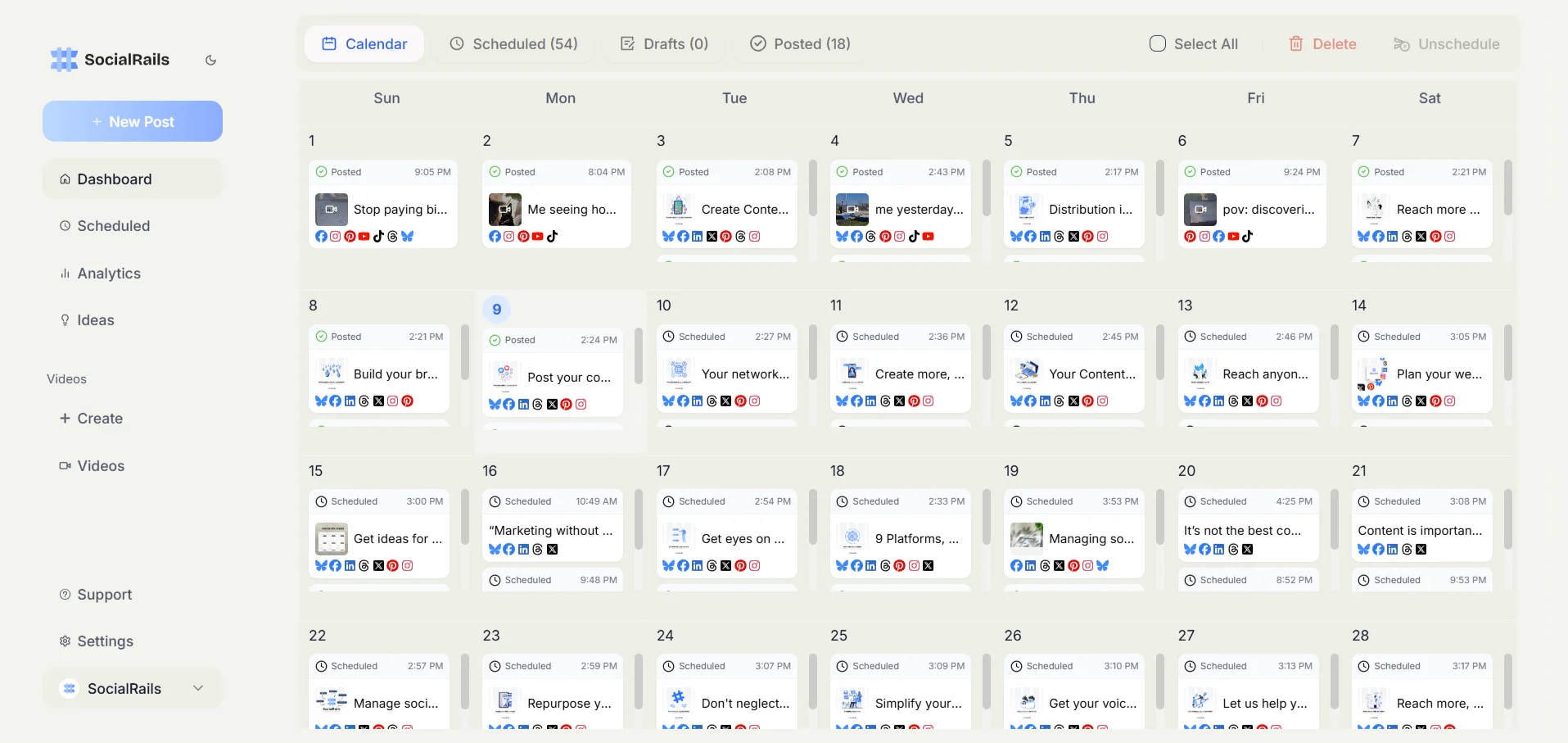
Which Tools Actually Support CSV Upload
Two rows in that table usually appear wrong elsewhere. Buffer's bulk upload is normally described as paid-only when it works on the Free plan too. And Hootsuite's is normally listed against its $99 Standard plan when the feature actually sits on Advanced at $399, four times the price. If you are choosing a tool on the basis of bulk upload, that difference is the whole decision.
Other tools including Later, Publer and Social Champ also offer bulk upload. Their limits and prices move often enough that quoting them here would date badly, so check the current figure on the vendor's own pricing page rather than trusting any comparison table, this one included.
Meta Business Suite: What It Actually Does
Meta Business Suite is free and it does schedule, but one post at a time.
- No CSV or spreadsheet import. Every post is created individually in the Planner.
- You can schedule posts, Reels and Stories up to 75 days ahead.
- There is a cap of roughly 25 scheduled posts per day, per account.
That 25 is where the myth comes from. "25 a day per account" gets rewritten as "25 posts per bulk upload", and once one guide prints it the rest copy it. It is a real Meta number attached to the wrong mechanism.
If you want Facebook and Instagram posts to come from a spreadsheet, you need a third-party tool that connects to them. Meta will not do it natively.
How to Bulk Upload on Buffer
Bulk upload is per channel, which is why it is not in the main composer and why people miss it.
Step 1: Open the Publish tab and select the channel you want to upload to
Step 2: Click the gear icon next to the channel name
Step 3: Open the General tab, then choose Bulk Upload
Step 4: Fill in the template. The column titles are case-sensitive and must match exactly:
Text: the post contentImage URL: optional, but required for InstagramTags: optional Buffer tags, not hashtagsPosting Time: optional, formatYYYY-MM-DD HH:mm
Pinterest needs an extra Board Name column, and accepts optional Title, Alt Text and Link.
Step 5: Upload, then review before confirming
Limits: 10 posts per channel per upload on the Free plan, capped by the queue slots you have left, and 100 per channel per upload on paid plans.
The one that trips people up: every row needs either text or an image URL. A row with only a posting time is rejected.
How to Bulk Upload on Hootsuite
Check the price before you start. Bulk Composer is not on the $99 Standard plan. It is on Advanced, $399 per user per month. Signing up for Standard expecting bulk upload is the single most common mistake with this tool.
Step 1: Open Planner, then Bulk Composer
Step 2: Download the CSV template
Step 3: Fill it in, keeping to the template's date and time format and using direct, publicly reachable media URLs
Step 4: Upload, choose the destination accounts, and review
Limit: 350 posts per profile per CSV. Some guides call this unlimited. It is not.
A Working CSV Structure
There is no universal format, so always start from the template your tool gives you rather than a generic one. That said, most templates are a variation of:
Text,Image URL,Posting Time
"Monday motivation post",https://example.com/image1.jpg,2026-01-25 09:00
"Lunchtime question: what are you working on today?",,2026-01-25 12:00
"Industry insight: three trends to watch this quarter",https://example.com/chart.png,2026-01-26 10:00
Rules that hold across tools:
- Match the template's column names exactly. Buffer's are case-sensitive; most are.
- Use 24-hour times.
14:00, not2:00 PM. - Wrap any text containing a comma in quotes, or the row splits into the wrong columns.
- Media must be a direct, publicly reachable URL. A Google Drive share link or anything behind a login will fail at publish time, not at upload time, which is the worst moment to find out.
- Test with five rows before uploading fifty. Every tool validates differently.
Batching Workflow
Weekly session, 1 to 2 hours: write the week's captions in a spreadsheet, gather the images, add hashtags and mentions, fill in the template, upload.
Monthly session, 3 to 4 hours: plan themes per week, produce 20 to 30 posts in one sitting, schedule two to three weeks at a time, and deliberately leave gaps.
Leave the gaps. A fully packed four-week queue is the reason bulk-scheduled accounts read as automated. You want room to respond to something that happens.
Best Practices
Do: review each post before confirming, test with a handful of rows first, keep image dimensions consistent, and schedule against your own analytics rather than a generic best-time chart.
Do not: schedule more than two to three weeks out, bulk schedule anything trend-dependent or time-sensitive, or assume a post published just because it uploaded. Check the queue after the first run.
Platform Notes
Instagram: only Business and Creator accounts can be scheduled by third-party tools. An Image URL is required on every row.
Facebook: Pages only. Personal profiles cannot be scheduled through the API, in bulk or otherwise.
LinkedIn: Company Pages are well supported by third-party tools. Personal profile scheduling is more limited.
TikTok: no native bulk scheduling. It has to come from a third-party tool that supports TikTok.
Frequently Asked Questions
Can you bulk upload posts to Meta Business Suite with a CSV?
No. Meta Business Suite has no bulk CSV or spreadsheet import. Every post is created individually in the Planner. It does schedule posts, Reels and Stories up to 75 days ahead, with a cap of roughly 25 scheduled posts per day per account, and that 25 is where the myth comes from: it gets rewritten as 25 posts per bulk upload. To schedule Facebook or Instagram posts from a spreadsheet you need a third-party tool.
Do you need a paid plan for Buffer bulk upload?
No. Bulk upload works on Buffer's Free plan, which is unusual and often reported incorrectly. Free allows up to 10 posts per channel per upload, limited by the queue slots you have left. Paid plans raise that to 100 posts per channel per upload. The limits are per channel rather than per upload overall, because the feature lives in each channel's settings.
Which Hootsuite plan includes bulk scheduling?
Advanced, at $399 per user per month. Bulk Composer is not included on the $99 Standard plan, which is the most common and most expensive mistake made with this tool. The limit is 350 posts per profile per CSV, not unlimited as many comparisons state.
How many posts can I bulk schedule at once?
It depends entirely on the tool and the plan. Buffer allows 10 per channel per upload on Free and 100 per channel on paid plans. Hootsuite allows 350 per profile on its Advanced plan. Meta Business Suite allows none, because it has no bulk upload. Treat any single number quoted without a plan attached as unreliable.
Can I bulk schedule posts with images?
Yes, but nearly every tool wants a direct, publicly reachable image URL rather than a file upload. A Google Drive share link, a Dropbox preview link or anything behind a login will typically pass the upload step and then fail at publish time, which is the worst moment to discover it. Test with a few rows first. On Instagram an image URL is mandatory on every row.
What happens if a bulk scheduled post fails?
Most tools notify you, but not always promptly, so check the queue yourself after the first run. The usual causes are an unreachable media URL, a column name that does not match the template exactly, a row with neither text nor an image, or a platform API error. Uploading successfully is not the same as publishing successfully.
Related Tools
- Content Calendar Generator, plan the schedule before you fill in the spreadsheet
- Instagram Caption Generator, draft captions in batches
Summary
- Meta Business Suite cannot do this. Free, useful, but one post at a time.
- Buffer is the cheapest real option, and bulk upload works even on its Free plan.
- Hootsuite needs the $399 Advanced plan, not the $99 one.
- Start from your tool's own template. Column names are case-sensitive and formats differ.
- Test five rows, then scale. And leave gaps in the queue.
Was this article helpful?
Let us know what you think!