

Rella Review 2026: Features, Pricing, Pros and Cons

Rella positions itself as the "easiest way to collaborate on content." It is built for agencies and content teams who run social media with client sign-off in the loop.
Pricing is per seat, from $24 to $64 per seat per month on annual billing, re-verified against Rella's own pricing page on 25 July 2026. The single most useful thing to know before you price it up is buried in Rella's documentation: clients who only view, comment or approve do not need a paid seat. That changes the maths considerably.
Create content, post everywhere
Create captions, images, and videos with AI. Schedule to 9 platforms in seconds.
Start your free trial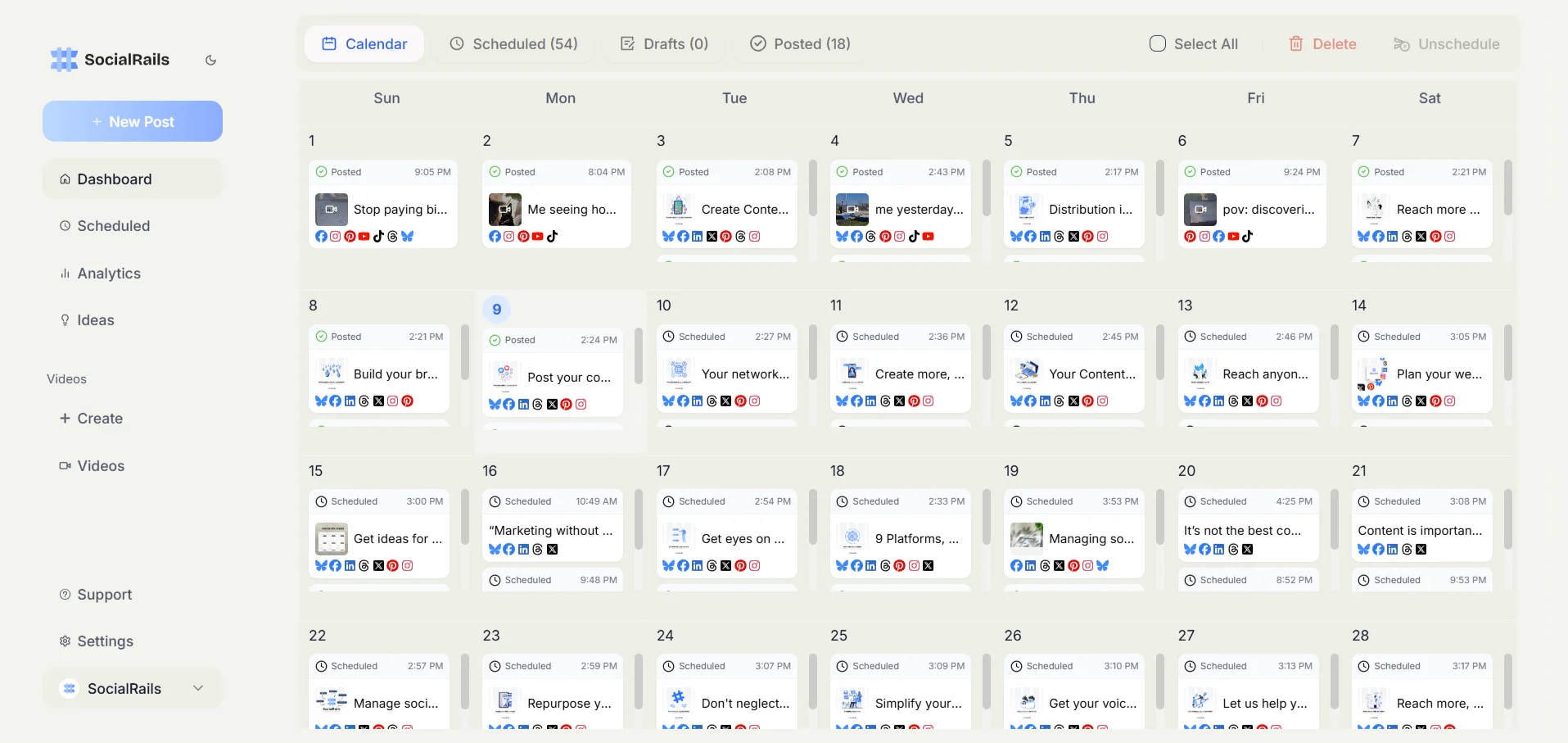

Jump to: Quick verdict | Pricing | Strengths | Weaknesses | Team cost | Alternatives | Who it suits | FAQ
Quick verdict
Best for: agencies and content teams who need client approval workflows and clean separation between clients.
Not ideal for: solo users, teams with many editors, or anyone who needs a specific platform Rella has not confirmed it supports.
Sourcing note: prices, plan contents and seat rules below come from Rella's own pricing page and documentation, checked 25 July 2026. Ratings are our editorial judgement. Where Rella does not publish something, this review says so rather than filling the gap with a guess.
Rella pricing in July 2026
Rella displays the annual rates and states that annual billing saves 20%. The month-to-month column is derived from that discount rather than observed directly, so treat those three figures as close estimates and confirm at checkout.
What separates the tiers:
- Pro: unlimited social profiles, auto posting, approvals, reporting, Instagram feed planner. Rella positions this tier at freelancers and solo managers.
- Premium: adds Ella, Rella's AI assistant, plus public communication, workflows, the Instagram inbox and advanced sharing. Rella's own plan guide describes Premium as the tier where Ella arrives.
- Premium Plus: adds unlimited Ella usage, white labelling, 1:1 onboarding and priority support.
Three rules that catch people out:
- Pricing is per seat on every tier. There is no flat-rate option.
- Everyone on the account must be on the same tier and the same billing frequency. You cannot put two people on Premium and the rest on Pro.
- Reviewers are free. Per Rella's documentation, anyone who only needs to view, comment or approve can do so through shared content without being part of your subscription. Only people who edit need a paid seat.
That third point is the one most reviews miss, and it materially changes the cost of running Rella at an agency. You pay for your editors, not for your clients.
Changed since our last check: Premium moved from $36 to $48 per seat per month on annual billing, and Premium Plus from $48 to $64. Pro is unchanged at $24. If you are on an older rate, you are on a legacy price.
Your agency has 8 people needing Rella access. What's the monthly cost on the Pro plan (annual billing)?
💡 Tip: Think carefully before selecting your answer!
What Rella does well
Client collaboration
This is the reason to choose Rella over a general-purpose scheduler.
Rella states that approvals can be shared at no extra cost, and that people who only view or comment access shared content and reports without joining your subscription. For an agency with five staff and thirty client-side stakeholders, that is the difference between a workable bill and an unworkable one.
Unlimited Social Spaces
Rella gives each client its own Social Space, and does not charge per space. Competitors that price per client calendar, HeyOrca being the obvious example, get expensive in exactly the scenario Rella handles cheaply: many clients, few editors.
Role separation
Three roles, which is enough structure without becoming a permissions maze:
- Admins see every Social Space and control billing, organisation settings and space creation
- Managers share content, projects and reports, invite managers and editors, manage statuses and analytics
- Editors create and edit content, manage feeds and connect social accounts
Visual planning
Drag-and-drop calendar, kanban board view, an Instagram feed planner and colour-coded status tracking. Solid rather than remarkable, but well suited to visual-first content.
What's Rella's biggest competitive advantage?
💡 Tip: Think carefully before selecting your answer!
Where Rella falls short
Per-seat pricing on every tier
There is no flat-rate plan. Every editor costs a full seat, and the tier-uniformity rule means one person needing a Premium feature pushes the whole team onto Premium. For a team of ten, that is the difference between $240 and $480 a month.
AI is gated and metered
Ella arrives on Premium, not Pro, and only Premium Plus removes usage limits. If AI assistance is central to how you work, the practical entry point is $48 per seat per month, not $24.
Platform support is not published
Rella's documentation names Instagram, TikTok, YouTube, LinkedIn and Facebook. Its marketing pages do not publish a complete supported-platform list. We could not confirm support for Pinterest, X, Threads, Bluesky, Mastodon or Google Business Profile one way or the other, so this review does not claim either. If a specific platform matters to you, confirm it during the trial before you commit a year of seats.
Analytics are improving but unproven here
Rella now advertises dashboards, demographics, AI insights and organic plus paid reporting, which is more than this review previously credited it with. We have not tested those reports against a dedicated analytics suite, so treat this as a note that the feature exists rather than a verdict on its depth. If competitor benchmarking, sentiment tracking or attribution reporting is core to your work, evaluate it specifically.
Which of these is true about Rella's pricing?
💡 Tip: Think carefully before selecting your answer!
What it actually costs a team
Annual billing, editors only. Remember that client-side reviewers add nothing.
The shape of this table is the whole decision. Rella is competitive when you have few editors and many clients. It gets expensive fast in the reverse case.
Pros and cons
Rella vs the alternatives
Each model wins in a different shape of business. Rella suits many clients and few editors. HeyOrca suits few clients and many users. Flat-rate tools suit teams that want a predictable bill as headcount moves.
Create content, post everywhere
Create captions, images, and videos with AI. Schedule to 9 platforms in seconds.
Start your free trialWho should use Rella
Good fit:
- Small agencies with three to five editors and a long list of client stakeholders, since the stakeholders cost nothing
- Content teams whose bottleneck is approvals rather than volume
- Anyone who needs genuine separation between clients rather than tags on a shared calendar
Look elsewhere if:
- You are solo. A full seat for one person buys collaboration features you will not use. See our Buffer review.
- You have many editors. Twenty editors on Premium is $960 a month. Flat-rate pricing wins at that scale.
- Analytics depth is the point. See Hootsuite or Sprout Social.
- You need a platform Rella has not confirmed. Verify during the trial.
FAQ
How much does Rella cost in 2026?
Do clients need to pay for a Rella seat to approve content?
Does Rella have a free plan?
Is Rella worth it in 2026?
Which plans include Rella's Ella AI?
Which social platforms does Rella support?
Can different team members be on different Rella plans?
How does Rella compare to HeyOrca?
Bottom line
Rella is a collaboration tool that happens to schedule, not a scheduler that happens to collaborate. Judge it on that.
Choose Rella if your editors are few, your clients are many, and approvals are where your process breaks down. Free reviewer access and unlimited Social Spaces make that shape genuinely cheap to run.
Choose something else if you have a lot of editors, you want a predictable flat bill, or you need a platform Rella has not confirmed it supports.
Related
Rella content
Similar reviews
- HeyOrca Review 2026, agency per-calendar pricing
- Planable Review 2026, visual collaboration
- Loomly Review 2026, team collaboration
- Kontentino Review 2026, agency workflows
Agency tool comparisons
Best-of guides
Building a shortlist from reviews? See reviews across every category.
Open the hubWas this article helpful?
Let us know what you think!