
12 Best Social Media Analytics Tools in 2026 (Free and Paid)

Quick answer: Start with free native analytics (Meta Business Suite, Twitter/X Analytics). Upgrade to a cross-platform tool like SocialRails or Sprout Social when you need unified reporting across multiple networks. If you're reporting to external clients rather than internal stakeholders, see our dedicated social media reporting tools for agencies shortlist, the buying criteria are different.
Quick Comparison
Create content, post everywhere
Create captions, images, and videos with AI. Schedule to 9 platforms in seconds.
Start your free trial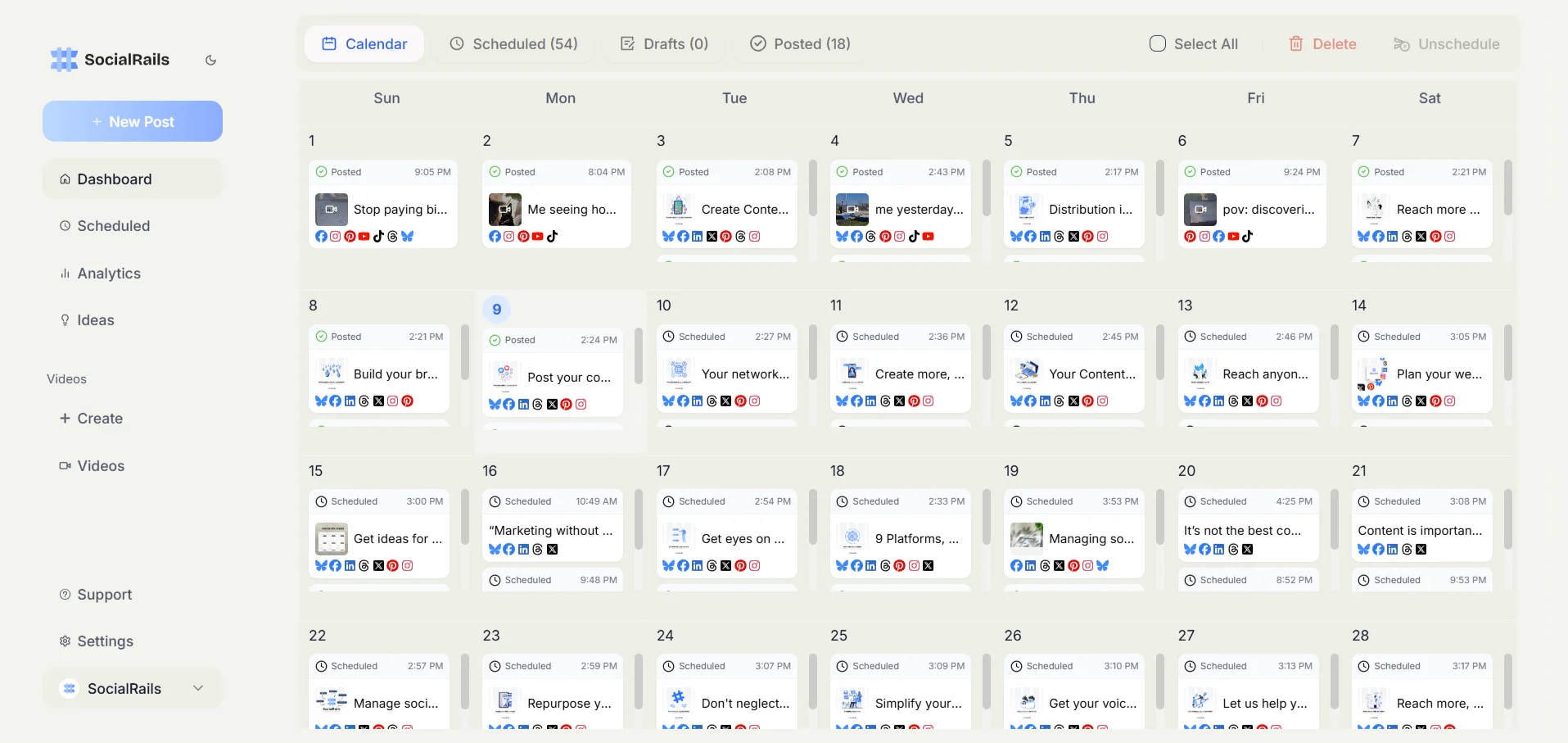
What to Look for in an Analytics Tool
Before picking a tool, figure out what you actually need:
- Multi-platform support: Do you need data from 2 platforms or 8?
- Reporting automation: Can it generate and email reports on a schedule?
- Competitive analysis: Does it track competitor performance?
- Custom metrics: Can you build dashboards around your KPIs?
- Export options: PDF, CSV, or API access for custom dashboards?
The biggest mistake teams make is buying a tool with features they will never use. A $199-per-seat platform is wasted if you only post on two networks and check stats once a week.
What should you define BEFORE choosing a social media analytics tool?
Detailed Tool Reviews
1. SocialRails
Best for: Teams that want scheduling, analytics, and reporting in one platform.
SocialRails pairs social media scheduling with built-in analytics across all major platforms. Performance dashboards, audience demographics, and automated reports all live in one place.
Key features:
- Cross-platform analytics for Instagram, Facebook, X, LinkedIn, TikTok, YouTube, Pinterest
- Automated weekly and monthly report generation
- Best time to post recommendations based on your data
- Competitor tracking and benchmarking
Pricing: Creator $29/month, Business $49, Agency $99. There is a 3-day free trial, but no free tier.
Verdict: Strong choice if you want analytics bundled with your scheduling workflow.
2. Sprout Social
Best for: Enterprise teams needing polished, presentation-ready reports.
Sprout Social excels at report customization. Build reports for different stakeholders (executives, clients, team leads) with drag-and-drop widgets.
Key features:
- Premium analytics with cross-network reporting
- Listening tools for brand mentions and sentiment
- Automated report scheduling and delivery
- Tag-based reporting to track campaigns
Pricing: From $99/seat/month (Essentials), then $199, $299 and $399 per seat.
Verdict: Powerful but expensive. Best justified for agencies or enterprise teams. See our Sprout Social review.
3. Hootsuite
Best for: Teams already invested in the Hootsuite ecosystem.
Hootsuite's analytics module covers the basics and integrates with its scheduling and inbox features. Nothing groundbreaking, but reliable.
Key features:
- Customizable dashboards with 200+ metrics
- Industry benchmarking
- ROI measurement for paid and organic
- Team performance reporting
Pricing: Starting at $99/month.
Verdict: Solid if you already use Hootsuite for scheduling. Not worth switching to just for analytics. See our Hootsuite review.
4. Buffer
Best for: Solopreneurs and small teams on a budget.
Buffer keeps analytics simple. Post-level performance, audience growth trends, and basic engagement metrics without the complexity.
Key features:
- Post performance with engagement breakdown
- Audience demographics
- Best time to post suggestions
- Simple exportable reports
Pricing: Free tier for up to 3 channels. Paid from $5/month per channel.
Verdict: Great starting point for small operations. Limited depth for advanced users. See our Buffer review.
5. Iconosquare
Best for: Brands focused heavily on Instagram and TikTok.
Iconosquare started as an Instagram analytics tool and still leads in that niche. It now covers Facebook, Twitter, LinkedIn, and TikTok too.
Key features:
- Advanced Instagram Story analytics
- Hashtag tracking and performance
- Competitor benchmarking
- Automated PDF reports
Pricing: Starting at $49/month.
Verdict: Top choice for Instagram depth. See our Iconosquare review.
6. Brandwatch
Best for: Large brands that need social listening paired with analytics.
Brandwatch (formerly Falcon.io) combines deep analytics with social listening, audience intelligence, and trend detection. It is built for teams that care about brand perception, not just post metrics.
Key features:
- AI-powered sentiment analysis
- Audience segmentation and personas
- Cross-platform analytics with listening integration
- Custom dashboards and alerts
Pricing: Custom pricing (typically $800+/month).
Verdict: Enterprise-grade. Overkill for small teams. See our Brandwatch review. Many analytics platforms now include AI features. See our AI social media tools guide for tools that combine analytics with AI content creation.
Which analytics tool is best known for detecting when competitors pay to promote posts?
7. Rival IQ
Best for: Competitive benchmarking and industry analysis.
Rival IQ shows how your social performance stacks up against competitors and industry averages. If you care about relative performance (not just absolute numbers), this is the tool.
Key features:
- Head-to-head competitor comparisons
- Boosted post detection (see when competitors pay to promote)
- Industry benchmark reports
- Automated competitive alerts
Pricing: Starting at $239/month.
Verdict: Unmatched for competitive intelligence. See our guide to social media competitor analysis tools.
8. Keyhole
Best for: Hashtag tracking and campaign measurement.
Keyhole excels at real-time tracking of hashtags, keywords, and campaign performance across social platforms. Acquired by Muck Rack in 2024, it's particularly useful for event marketing and influencer campaigns.
Key features:
- Real-time hashtag tracking
- Influencer analytics and identification
- Campaign wall and event monitoring
- Sentiment analysis across platforms
Pricing: Starting at $179/month (Professional plan, 3 account trackers). See our full Keyhole pricing breakdown.
Verdict: Strong for campaign-centric teams, but analytics-only with no scheduling. Read our Keyhole review or compare Keyhole alternatives.
9. Emplifi (formerly Socialbakers)
Best for: Enterprise brands that integrate social analytics with customer experience.
Emplifi connects social media analytics with customer care data. The result is a unified view of brand health that spans marketing and support.
Key features:
- AI-powered content intelligence
- Cross-platform benchmarking
- Unified social and CX analytics
- Influencer identification and tracking
Pricing: Custom pricing.
Verdict: Best for enterprise teams with customer service integration needs. See our Emplifi review.
10. Google Analytics
Best for: Tracking how social media drives website traffic and conversions.
Google Analytics does not measure social media metrics directly. It shows you what happens after someone clicks through from social to your website, which is where the money is.
Key features:
- Traffic source attribution (which platform sends the most visitors)
- Conversion tracking from social referrals (including retargeting campaigns)
- User behavior flow from social traffic
- Campaign URL tracking with UTM parameters
- Set up via analytics.google.com
Pricing: Free.
Verdict: Essential companion to any social media analytics tool. Shows the business impact that platform analytics miss.
11. Meta Business Suite
Best for: Facebook and Instagram page analytics at no cost.
Meta Business Suite provides detailed analytics for your Facebook and Instagram accounts. Post performance, audience demographics, and ad results are all included.
Key features:
- Post reach and engagement metrics
- Audience demographics and insights
- Content performance trends
- Ad performance integration
Pricing: Free.
Verdict: Must-use if you are active on Facebook or Instagram. Limited to Meta platforms only.
12. Native Platform Analytics
Best for: Quick checks on individual platform performance.
Every major platform offers built-in analytics:
Pricing: Free with a business/creator account.
Verdict: Good starting point. The limitation is you cannot compare across platforms or automate reports.
How to Choose the Right Tool
Budget under $50/month: Start with native analytics plus Buffer's free plan, or SocialRails Creator at $29/mo.
Budget $50-250/month: SocialRails, Iconosquare, or Keyhole depending on your primary platform.
Budget $250+/month: Sprout Social or Rival IQ for full reporting and competitive analysis.
Enterprise (custom pricing): Brandwatch or Emplifi for listening, CX integration, and advanced AI.
Match the tool to your actual workflow. A solopreneur posting on two platforms does not need a per-seat enterprise suite. An agency managing 20 clients cannot survive on free native tools alone.
A small team posts on Instagram and LinkedIn only, with a budget under $50/month. What is the best analytics setup?
Frequently Asked Questions
Do I need a paid tool for social media analytics?
What social media metrics should I track?
Can I use multiple analytics tools at the same time?
How often should I check my social media analytics?
What is the difference between analytics and social listening?
Getting Started With Social Media Analytics
- Define your KPIs. Decide what success looks like before choosing a tool. See our social media ROI guide for a framework.
- Start free. Use native analytics and free tiers for 30 days to understand your baseline.
- Audit monthly. Use our guide on measuring social media performance to build a review cadence.
- Benchmark competitors. Tools like Rival IQ or SocialRails help you understand performance in context.
For platform-specific analytics guides, see:
Was this article helpful?
Let us know what you think!