
11 Best Social Media Tools for Beauty Brands in 2026

Beauty is the most visually competitive category on social media. The brands that win in 2026 aren't the ones with the biggest budgets. They're the ones with a stack built for high-frequency UGC, creator partnerships, and pixel-perfect product visuals.
This guide ranks the 11 tools that beauty brands (indie, DTC, and established) use to drive product discovery, virtual try-ons, and content velocity.
Skip to: What Matters for Beauty | 11 Tools | Stacks | Launch Workflow
Create content, post everywhere
Create captions, images, and videos with AI. Schedule to 9 platforms in seconds.
Start your free trial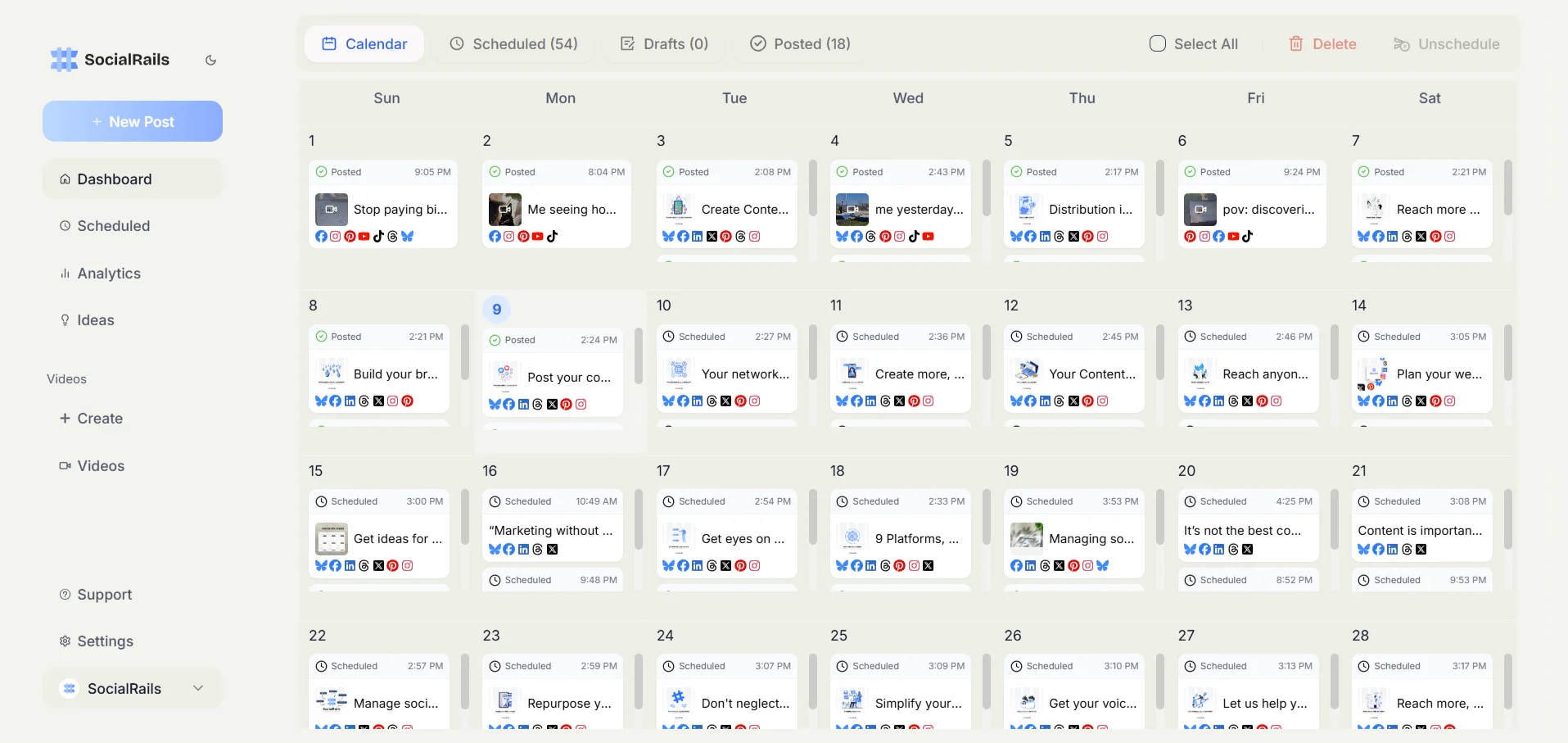
The 30-Second Answer
Best overall scheduler: SocialRails. Multi-platform with brand-kit caption AI, calendar view for product drop coordination, and flat pricing.
For Instagram-first brands: Later (visual planner + Linkin.bio). For UGC and creator programs: Aspire, GRIN, or LTK Connect. For TikTok Shop: Bazaarvoice + native TikTok Creator Marketplace. For virtual try-on: Banuba or Perfect Corp / YouCam. For shoppable Instagram: Meta Commerce Manager + Tagshop.
Beauty social media has six jobs: launch buzz, ongoing UGC, creator partnerships, shoppable content, virtual try-on, and retention. Every tool below maps to one or more.
What Drives Beauty Brand Growth on Social
1. UGC volume. Beauty buyers trust other buyers. Brands that systematize UGC (asking for it at unboxing, rewarding it, reposting it) outsell brands that don't.
2. Creator partnerships at scale. Not one mega-influencer, 50 micro-creators. The economics changed in 2024-2025; affiliate-led creator programs now beat paid mega-influencer deals on ROAS.
3. Shoppable everything. Instagram Shops, TikTok Shop, YouTube Shopping. The friction between "I see it" and "I buy it" is the #1 lever.
4. Virtual try-on. Lipstick shades, foundation undertones, blush, beauty has the highest virtual try-on conversion lift of any category.
5. Tutorial + transformation content. Reels/TikToks of the product in use tend to convert noticeably better than product-only shots.
The 11 Best Social Media Tools for Beauty Brands
1. SocialRails (Best Overall Scheduler)
Why it fits beauty: Multi-account support for parent brand + sub-brands, calendar view that handles product drops, AI captions that match your brand voice, and Stories scheduling for unboxing content. Flat pricing scales with channels, not seats.
Pricing: Free tier; paid from $24/mo Try: SocialRails
2. Later
Why: Linkin.bio drives traffic to multiple PDPs from one Instagram link. Visual planner perfect for grid aesthetic, critical for beauty. Pricing: From $25/mo
3. GRIN (Creator Marketing Platform)
Why: End-to-end creator program management: discovery, contracts, content rights, performance. Widely adopted by DTC beauty brands. Pricing: Custom (mid-market: $1,500-3,000/mo)
4. Aspire (Best for Mid-Size Beauty)
Why: Influencer marketplace + brief management + UGC rights. More affordable than GRIN, more powerful than DIY. Pricing: Custom (typically $500-1,500/mo)
5. LTK Connect (Affiliate Beauty Powerhouse)
Why: LTK creators drive a disproportionate share of beauty discovery. LTK Connect is the brand-side platform to recruit and pay creators on commission. Pricing: $99-499/mo + commission
6. Bazaarvoice
Why: Aggregates reviews + UGC across channels and pushes them back into product pages and social. Widely used by enterprise beauty retailers. Pricing: Custom enterprise
7. Tagshop / Pixlee
Why: UGC galleries that you embed in your storefront and pull from social. Auto-permission requests and rights flow. Pricing: From $30-200/mo
8. Perfect Corp / YouCam
Why: Virtual try-on that integrates with Instagram, TikTok, and your website. Lipstick, eyeshadow, foundation, hair color. The category leader. Pricing: Custom (per-product or platform fee)
9. Banuba
Why: Cheaper alternative to Perfect Corp for AR try-on. Better SDK for indie brands building custom experiences. Pricing: Custom
10. Canva Pro / Adobe Express
Why: Brand-kit templated design for product cards, ingredient breakdowns, and Reel covers. Your social manager + a design system in a box. Pricing: $15/mo (Canva), $9.99/mo (Adobe Express)
11. CapCut + InShot
Why: Free mobile video editors aligned with TikTok and Reels trends. Most beauty Reels that perform on TikTok and Instagram are CapCut-edited. Pricing: Free; Pro from $9.99/mo
Comparison Table
Recommended Stacks
Indie beauty brand (under $1M/yr)
- SocialRails or Later
- Canva Pro
- CapCut
- LTK Connect (start here for creators)
- Pixlee free trial / Tagshop entry tier Total: $130-200/mo
Mid-market DTC beauty ($1-10M/yr)
- SocialRails
- Aspire (creator program)
- Bazaarvoice or Tagshop (UGC)
- Banuba (AR try-on, cheaper than Perfect Corp)
- Canva Pro Teams Total: $1,000-3,000/mo
Established beauty brand ($10M+)
- Sprinklr or SocialRails Enterprise
- GRIN (creator program)
- Bazaarvoice (reviews + UGC at scale)
- Perfect Corp (top-tier AR)
- Internal design team + Canva Total: $10,000+/mo
The Beauty Product Launch Workflow on Social
A new shade or product launch should run a 6-week social arc:
Week -6: Tease
- Lifestyle Reel of unbranded teaser (texture, color, application)
- Story poll: "Guess what's coming"
Week -4: Reveal
- Hero Reel + carousel announce
- Email + DM blast to existing customers
- Brief 20-30 micro-creators with product samples
Week -2: Drop creator content
- 20+ creator posts, all tagged
- Repost top 5 to brand account
- Run paid amplification on highest-performing
Week 0: Launch
- Live launch event on Instagram + TikTok
- Linkin.bio updated to new product
- Email + SMS blast
- TikTok Shop or Instagram Shop tag enabled
- AR try-on filter live
Week +2: UGC harvest
- Repost first wave of customer content
- Feature reviews in carousels
- Run "How are you wearing it?" Stories prompt
Week +4: Tutorial wave
- 3-5 tutorial Reels (eye looks, full face, etc.)
- Educational content (ingredient story, how-to)
This is the rhythm. A scheduler like SocialRails or Later lets one social manager run this arc across 4-6 platforms simultaneously.
You're an indie beauty brand under $500k revenue. Where should your first creator marketing dollar go?
💡 Tip: Think carefully before selecting your answer!
Frequently Asked Questions
What's the best social platform for beauty brands?▼
Instagram for ages 25-45, TikTok for ages 16-30, YouTube for tutorials and SEO, Pinterest for inspiration boards (still strong for beauty). Most brands need all four; indie brands can start with Instagram + TikTok.
How often should a beauty brand post?▼
Feed: 5-7 posts/week. Stories: 5-10/day. Reels: 4-7/week. TikTok: daily. Frequency matters less than consistency, 5/week consistently beats 10/week sporadic.
Are virtual try-on tools worth the cost?▼
Yes for color cosmetics (lipstick, eyeshadow, foundation, blush) and hair color, where shoppers commit faster when they can preview the result. Skip for skincare and fragrance, where AR doesn't help the buying decision.
What's the difference between GRIN and Aspire?▼
GRIN is more enterprise (better for $5M+ brands with 100+ creators in program). Aspire is more accessible (better for $1-5M brands building their first creator program). Both handle discovery → contracts → content rights → performance.
Should beauty brands focus on TikTok Shop or their own DTC site?▼
Both. TikTok Shop drives discovery and impulse buys; your DTC site drives repeat orders and higher AOV. Tag products in TikToks, but build email list to drive customers off-platform.
How do beauty brands handle product complaints on social?▼
Have a dedicated DM workflow: triage within 4 hours, escalate adverse reactions to medical info, never argue publicly. Tools like Sprout Social and Khoros help at scale; ManyChat works for indie.
Conclusion
Beauty wins on social with creator volume, UGC velocity, and shoppable content, not with one viral campaign. The 2026 stack is a multi-platform scheduler, a creator program tool sized to your stage, UGC collection, and AR try-on for color products.
Indie brands should start with the cheapest version of each layer. Mid-market should invest in creators and UGC depth. Established brands should automate everything and focus on retention.
Related Reading
Industry Marketing:
- Best Social Media Tools for Boutiques
- Best Social Media Tools for Cafes and Coffee Shops
- Hair Salon Social Media Marketing
- Spa Social Media Marketing
Tools & Strategy:
Free Tools:
- Beauty Reels Script Builder
- Beauty Username Generator
- Caption Generator
Was this article helpful?
Let us know what you think!