
10 Best Social Media App Builders & Tools for App Developers (2026)

"Best social media app builder" is two questions in one search box:
- Builders: tools to actually build a social media app (no-code platforms, frameworks, BaaS providers).
- Tools for developers: schedulers and growth tools that app developers use to market their app on social.
This guide covers both. The first half ranks the no-code and code-first platforms for shipping a social app. The second half ranks the marketing tools that turn a launched app into installs.
Skip to: App Builders | No-Code Options | Code Frameworks | Marketing Tools | Recommended Stacks
Create content, post everywhere
Create captions, images, and videos with AI. Schedule to 9 platforms in seconds.
Start your free trial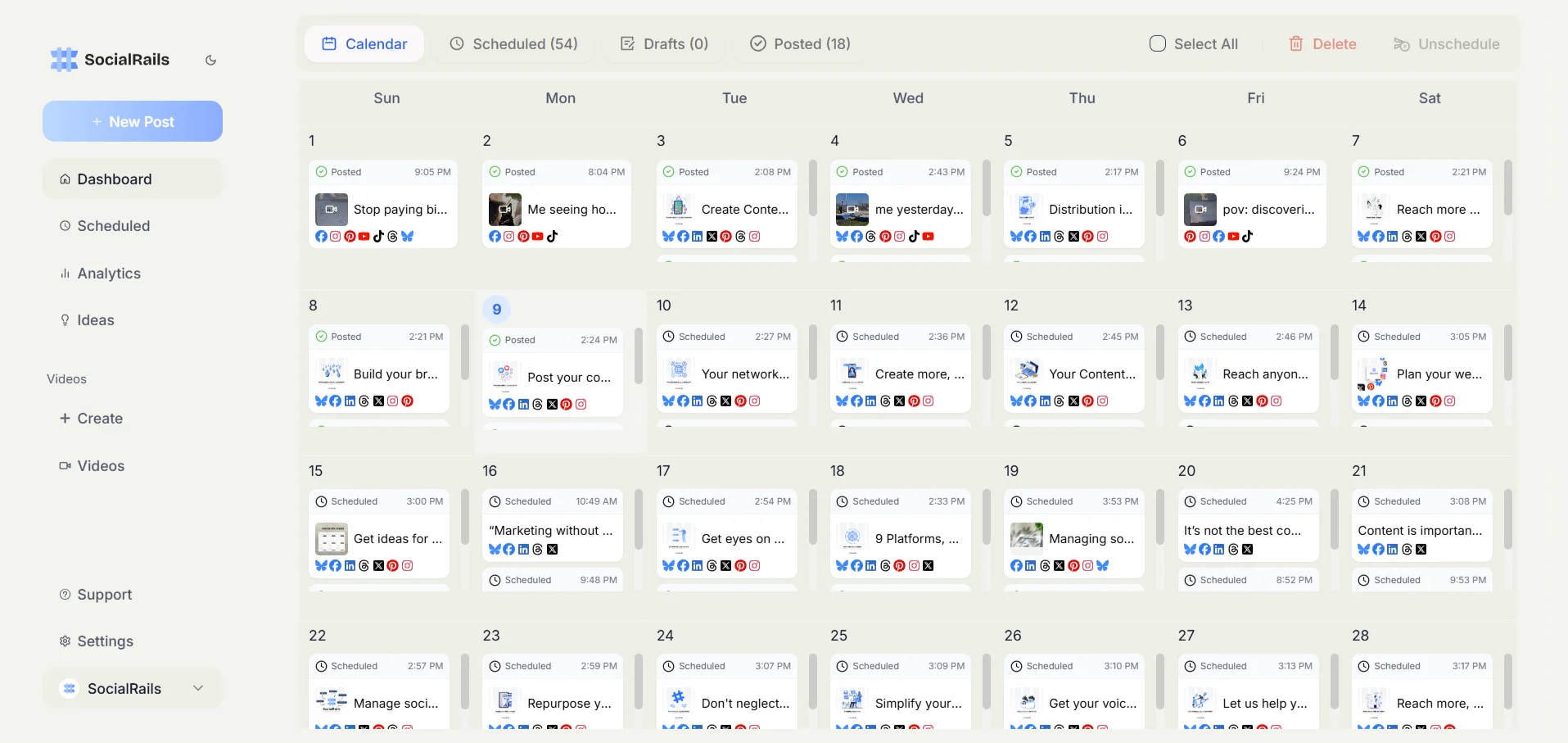
The 30-Second Answer
To build a social media app, no-code: Bubble or Glide. Both ship a working MVP in days. To build a social media app, code-first: React Native + Supabase + Stream Chat. The standard 2026 stack for indie apps. To launch and grow your app on social: SocialRails for cross-platform scheduling + Sensor Tower or Appfigures for ASO. To skip building entirely: Use a white-label like Mighty Networks or Circle.so. You'll go live this week.
The right answer depends on whether you're a founder, a developer, or a marketer. Keep reading.
Building a Social Media App: The 4 Paths
The mistake most non-technical founders make: assuming they need code-first when a white-label or no-code would ship far faster and validate the idea before spending engineering time.
Best No-Code Social App Builders
1. Bubble (Best No-Code Power)
What it is: Full no-code platform, visual database, workflows, responsive UI.
Why it works for social apps:
- Real auth, user profiles, feeds, comments, likes
- Plugin marketplace including chat, video, push notifications
- Native iOS/Android wrap available via partners (BDK, JasonElle wrap, or BubbleApp)
- Production-grade scaling
Limits: Performance plateaus at 100k+ active users without serious optimization. Native feel is good, not perfect.
Pricing: Free starter; paid from $32/mo Build time: 2-4 weeks for a TikTok-like MVP
2. Glide (Best Database-Driven Social Apps)
What it is: Spreadsheet-to-app builder, mobile-first.
Why it works:
- True native-feeling iOS/Android via PWA + wrappers
- Built-in user profiles, comments, posts
- Best when your data model is simple (posts, users, follows)
Limits: Less flexible than Bubble for complex feeds and algorithms.
Pricing: Free for 10 users; paid from $25/mo Build time: 1-2 weeks for a Threads-like MVP
3. FlutterFlow (Best No-Code-to-Native Bridge)
What it is: Flutter-based no-code that exports real Flutter code.
Why developers like it:
- Real native performance (it compiles to Flutter)
- Eject to code if you outgrow no-code
- Firebase + Supabase backends
- Strong design system and prebuilt social templates
Limits: Steeper learning curve than Bubble; you'll touch some code eventually.
Pricing: Free; paid from $30/mo Build time: 2-6 weeks for a polished social MVP
4. Adalo (Best for Simple Mobile-First)
What it is: Mobile-native no-code with App Store and Play Store publishing.
Why founders like it:
- Publishes real apps to App Store + Play Store
- Friendly drag-and-drop
- Templates for chat, marketplace, social
Limits: Performance is OK for under 10k users; database queries get slow at scale.
Pricing: Free; paid from $45/mo Build time: 2-3 weeks for a niche social MVP
5. Mighty Networks / Circle.so (Best White-Label Community)
What it is: Pre-built community-as-an-app, feeds, courses, events, chat, monetization.
Why creators choose it:
- Live this week, no build
- Polished iOS + Android apps with your branding
- Built-in monetization (subscriptions, courses)
- Community features that would take 6 months to recreate
Limits: You're inside their box, limited custom features. White-label costs extra.
Pricing: Mighty from $41/mo; Circle from $89/mo Build time: 1-3 days
If your "social app" is really a community for a niche, this path beats everything else.
Best Code Frameworks for Social Apps
For developers building a social app from scratch, the proven 2026 stacks:
6. React Native + Supabase + Stream
The default indie stack:
- React Native: cross-platform iOS/Android from one codebase
- Supabase: Postgres + auth + realtime + storage
- Stream: chat and feeds API (you don't write feed ranking yourself)
- Expo: build, OTA updates, push notifications
Why it wins: You can ship a TikTok-like app with a small team in 3-4 months. Supabase + Stream takes the two hardest parts (auth + realtime feeds) off your plate.
7. Flutter + Firebase
Google's preferred stack:
- Flutter: single codebase, beautiful native UI
- Firebase: auth, Firestore, Cloud Functions, Cloud Messaging
- Algolia or Typesense: for search
Why some teams pick it: Flutter's UI consistency across platforms is unmatched. Firestore makes social-graph queries simple at small scale.
When to skip: Firestore pricing scales painfully at high read volume, heavy social feeds get expensive fast.
8. Next.js / React + Stream + Clerk + PlanetScale
Web-first social platform stack:
- Next.js: SSR for SEO and performance
- Stream: feeds + chat
- Clerk: auth (faster than rolling your own)
- PlanetScale or Neon: managed database
- Capacitor or Tauri: wrap web → native if needed
When this wins: Forum-style or essay-driven communities (Substack-like, Mastodon-like). Web is your primary surface.
9. Native iOS (Swift) + Android (Kotlin)
The "we're going to scale" stack:
- True native, max performance
- Direct platform API access (camera, AR, vision)
- Required for apps that compete with TikTok, Instagram, BeReal on UX polish
Cost: Substantially more engineering than cross-platform. Worth it for top-tier UX, not for MVPs.
Comparison: No-Code vs Code-First for Social Apps
You're a non-technical founder. Your idea is a social app for amateur photographers, feed, follows, comments, likes. What's the right starting path?
💡 Tip: Think carefully before selecting your answer!
Best Social Media Tools for App Developers (Marketing Side)
Once your app is live, marketing it on social is its own discipline. The tools that move installs:
10. SocialRails (Best Cross-Platform Scheduling for Indie Devs)
What it does: Schedules content across X, LinkedIn, Threads, Instagram, TikTok, YouTube Shorts, and more.
Why app devs love it:
- Build-in-public posting on a queue
- Cross-post launch announcements with platform-specific copy
- AI captions for changelogs, demos, milestone posts
- Flat pricing, doesn't punish solo devs adding channels
- Calendar view for coordinating launches
Pricing: Free tier; paid from $24/mo Try SocialRails
Sensor Tower / Appfigures (Best ASO + Competitor Research)
What they do: App Store Optimization, competitor download estimates, keyword tracking.
Why ASO matters: A large share of app discovery still happens in App Store / Play Store search. Social drives awareness; ASO closes the install. You need both.
Pricing: Both have free tiers; paid from $49-99/mo
Buffer (Best Free Tier for Solo Devs)
Why solo founders use it: Free for 3 channels, simple, gets out of your way. Many indie devs run Buffer free + Twitter/X heavy.
Loops (Best for Build-in-Public Threads)
What it is: Long-form thread composer for X/Twitter and LinkedIn.
Why dev marketers like it: Build-in-public posts and milestone threads are the #1 distribution channel for indie devs. Loops makes them faster to ship.
TestFlight + Reddit + Product Hunt (Best Launch Channels)
Not a tool, a playbook. App devs underuse these:
- TestFlight for beta + ambassadors
- Reddit subs (r/SideProject, r/ThisWeekInRedis, niche subreddits)
- Product Hunt for the launch-day install spike
A launched app on Product Hunt without a queued social media campaign is a wasted launch.
Recommended Stacks by Founder Type
Non-technical founder validating an idea
- Builder: Bubble or Glide
- Backend: built into the no-code tool
- Marketing: Buffer free + manual posting + Product Hunt
- Total cost: $30-50/mo
Solo developer shipping an indie app
- Builder: React Native + Expo + Supabase + Stream
- Marketing: SocialRails + Sensor Tower free + Loops
- Build-in-public: X + Threads + LinkedIn
- Total cost: $50-150/mo
Funded startup building a serious social app
- Builder: React Native (or native) + custom backend + Stream / SendBird for chat + Algolia
- Marketing: SocialRails or Hootsuite + Sensor Tower paid + Apple Search Ads
- Total cost: $500-3,000/mo
Creator launching a community-as-an-app
- Builder: Mighty Networks or Circle.so (white-label)
- Marketing: SocialRails + email (Kit, formerly ConvertKit, or Beehiiv)
- Total cost: $80-250/mo
Common Mistakes When Building or Launching a Social App
- Coding the feed algorithm yourself. Use Stream or SendBird. Feed ranking is a multi-year R&D problem you don't need to solve to validate.
- Skipping the build-in-public phase. The first 1,000 users of most indie social apps come from the founder's X / Threads / LinkedIn presence, not paid acquisition.
- Going native too early. Cross-platform (RN, Flutter) gets you most of the way to native UX at a fraction of the engineering cost.
- Launching without push notifications. Push notifications meaningfully improve retention for social apps. Plan it from day 0.
- Skipping content moderation. A social app without trust + safety becomes 4chan in 90 days. Use OpenAI's moderation API or Hive Moderation from launch.
- Building a "Twitter for X" without a unique mechanic. The successful 2020-2026 social apps (BeReal, Threads, Discord) have one obvious mechanic that's not Twitter.
- Not running ASO from day 1. Title, subtitle, screenshots, and reviews drive most installs. Treat your App Store page as a landing page.
You've shipped a no-code MVP and have 200 DAU. The app is sticky. What's the right next move?
💡 Tip: Think carefully before selecting your answer!
Frequently Asked Questions
Can I really build a social media app with no code?▼
Yes, for an MVP and even production at small scale (under 50k DAU). Bubble, FlutterFlow, and Adalo are all proven for live social apps. For scale ambitions beyond 100k DAU, plan to migrate to code-first eventually.
What's the cheapest way to build a social media app?▼
Mighty Networks or Circle.so as a white-label community at $40-90/mo. You'll be live in days. Skip if you need a custom-feeling app surface.
How long does it take to build a TikTok clone?▼
No-code MVP: 4-8 weeks. Code-first MVP: 4-6 months with a small team. Production-grade with feed ranking, recommendations, and creator tools: 12-18 months. Stream's video feed API cuts that significantly.
What backend should I use for a social app?▼
Supabase (Postgres, auth, realtime, storage) is the 2026 indie default. Firebase is the alternative if you prefer Google's stack. For chat and feeds specifically, Stream or SendBird are far cheaper than building yourself.
How do app developers market their apps on social media?▼
The pattern that works in 2026: build-in-public on X + Threads, demo videos on TikTok + Reels, weekly milestone posts on LinkedIn, launch on Product Hunt, schedule everything with a tool like SocialRails. Pair social with ASO so install intent → conversion.
What's the best social media platform for app developer marketing?▼
X for build-in-public + dev community. LinkedIn for B2B SaaS apps. TikTok + Reels for consumer apps. Reddit for niche audiences. YouTube for tutorials and trust. Skip Pinterest unless your app is in lifestyle/finance/recipe space.
Are there social media APIs I can use to add social features to my app?▼
Yes. Stream (feeds + chat), SendBird (chat), Pusher (realtime), Algolia (search), Hive (moderation), OneSignal (push), and Onfido (KYC). Compose them into a 90% solution before building anything in-house.
Conclusion
The fastest path from idea to launched social app in 2026 is rarely "hire engineers and ship in 6 months." For most founders, it's: validate in 4 weeks with no-code or a white-label, market on social with a scheduler from day 1, then invest in code-first once usage proves the idea.
The marketing side matters as much as the build. App developers who win build a social media presence alongside their app, not after, and use a scheduler so they can ship code and ship content in the same week.
Related Reading
Tools & Stacks:
- Best Social Media Tools for Marketing Teams
- Best Social Media Scheduler
- Tools for Entrepreneurs
- Tools for Content Creators
- Best AI Tools for Social Media
Strategy & Marketing:
Industry Hubs:
- Social Media by Industry
- Best Social Media Tools for Bloggers
- Top Social Media Blogs to Read
- Social Media Scheduler for Agencies, if you build apps for clients
Was this article helpful?
Let us know what you think!