
30 Best Tools for Content Creators in 2026 (By Category)

Quick Answer: The best tools for content creators in 2026 depend on your content type and budget. For social media scheduling, use SocialRails (3-day free trial, then $29/mo), Later, or Buffer. For video editing, CapCut is free and powerful for short-form, while DaVinci Resolve handles professional editing at no cost. Canva covers design, and ChatGPT or Claude handle AI writing. Beginners can build a complete toolkit for $0. Growing creators typically invest around $70 to $100/month. Below, we break down 30 tools across 8 categories with pricing, pros, cons, and which creator type each tool fits best.
Create content, post everywhere
Create captions, images, and videos with AI. Schedule to 9 platforms in seconds.
Start your free trial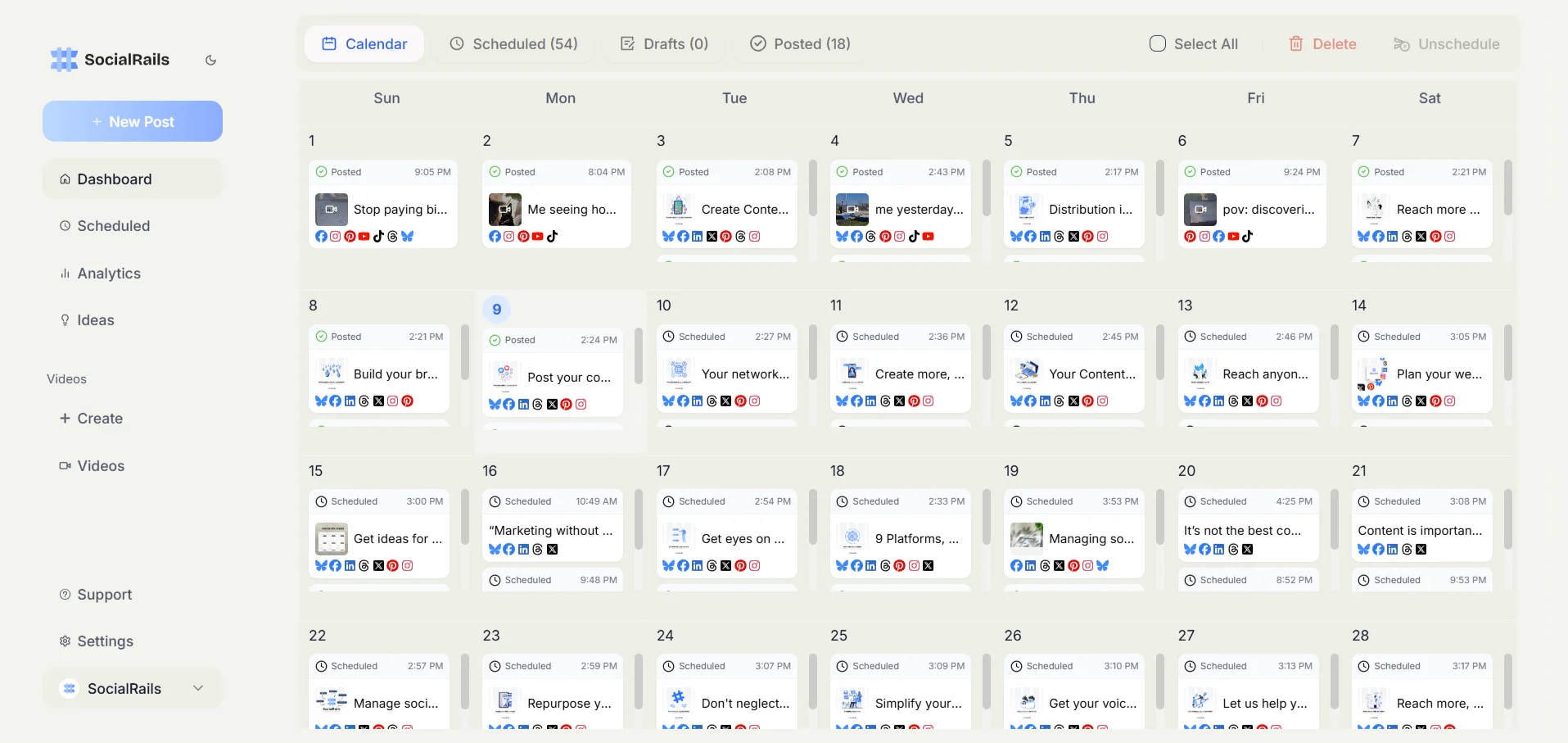
Whether you're a YouTuber, TikToker, podcaster, or multi-platform creator, the tools you use directly impact the quality and consistency of your output. But with hundreds of creator tools available, choosing the right ones is overwhelming.
This guide organizes 30 content creator tools into 8 categories based on what they actually do in your workflow. Each tool includes pricing, who it's best for, and honest pros and cons, so you can build a toolkit that matches your budget and content type.
What changed in 2026: A few names to know before you shop. Anchor is now Spotify for Creators, and hosting and analytics center on Spotify's own ecosystem. ConvertKit finished its rebrand to Kit and raised Creator pricing in late 2025, so the old entry-level tier is gone. Meta's old Creator Studio is fully replaced by Meta Business Suite. Every price below reflects mid-2026 published rates and can change, so confirm on each vendor's own site before you buy.
Jump to a category:
- Social Media Management
- Video Editing
- Design & Graphics
- AI Writing & Content
- Project Management & Organization
- Analytics & Performance
- Monetization & Business
- Free Tools
Quick Comparison: Content Creator Tools by Category
Social Media Management Tools
Social media schedulers handle the most time-consuming part of content creation: distributing your content across platforms consistently. The right scheduler saves hours per week and helps you post at optimal times.
For platform-specific content ideas, see our guides for Instagram, TikTok, YouTube, and LinkedIn.
1. SocialRails
Best for: Solo creators and small teams managing multiple platforms
- Schedule posts across all major platforms (Instagram, TikTok, LinkedIn, X, Facebook, Pinterest)
- Visual content calendar with drag-and-drop
- Analytics dashboard with best posting time recommendations
- Hashtag research and suggestions
- Team collaboration features on Agency plan
Pricing: 3-day free trial · Creator $29/mo (unlimited posts, 10 accounts) · Business $49/mo (20 accounts, 5 team members) · Agency $99/mo (30 accounts, 15 team members)
Pros: Affordable for what you get, clean interface, reliable scheduling Cons: Fewer integrations than enterprise tools like Hootsuite
2. Later
Best for: Instagram-first creators who care about visual feed planning
- Visual Instagram grid planner (preview how your feed will look before posting)
- Stories and Reels scheduling
- Linkin.bio tool for driving traffic from Instagram
- User-generated content discovery
Pricing: 14-day free trial · Starter $25/mo · Growth $50/mo · Advanced $80/mo (annual billing discounts these)
Pros: Best visual planning for Instagram, solid mobile app Cons: Less useful if Instagram isn't your primary platform
For more scheduling options, see best social media scheduler or best LinkedIn scheduler. If your content runs on a blog rather than a feed, the best social media tools for bloggers covers blog-to-social converters and Pinterest engines that purely scheduling stacks don't.
3. Buffer
Best for: Creators who want the simplest possible scheduling tool
- Clean, minimal interface focused on scheduling
- Multi-platform posting (Instagram, Facebook, X, LinkedIn, Pinterest, TikTok)
- Start Page (simple landing page builder)
- AI Assistant for caption generation
Pricing: Free (3 channels) · Essentials $6/mo per channel · Team $12/mo per channel
Pros: Easiest tool to learn, transparent per-channel pricing Cons: Analytics less detailed than SocialRails or Later
See also: Buffer review · Buffer alternatives · Cheaper than Buffer
4. Hootsuite
Best for: Established creator businesses with teams and clients
- Multi-platform management with unified inbox
- Advanced analytics and custom reporting
- Social listening and monitoring
- Team collaboration with approval workflows
Pricing: Standard $99/seat/mo · Professional $199/seat/mo · Advanced $399/seat/mo · Enterprise custom. Hootsuite retired the flat Team plan and now bills per seat.
Pros: Most comprehensive feature set, strong team management Cons: Expensive for solo creators, interface can feel complex
See also: Hootsuite review · Cheaper than Hootsuite
5. Postiz
Best for: Tech-savvy creators wanting open-source control
- Open-source and self-hostable (run it on your own server)
- AI image and video generation built in
- Supports niche platforms: BlueSky, Mastodon, Threads
- Full control over your data
Pricing: Self-hosted: Free · Managed: $23 to $79/mo
Pros: Free if self-hosted, supports niche platforms most tools ignore Cons: Self-hosting requires technical knowledge
See our Postiz review and Postiz pricing guide.
Video Editing Tools
Video is the dominant content format across YouTube, TikTok, Instagram Reels, and LinkedIn. Your video editor is often the tool you spend the most time in.
6. CapCut
Best for: TikTok, Reels, and Shorts creators (mobile and desktop)
- Free desktop and mobile editor with no watermark
- Direct TikTok integration and export
- Auto-captions with customizable styles
- Large template and effects library
- Keyframe animation for more advanced edits
Pricing: Free (most features) · Pro $7.99/mo (extra assets and storage)
Pros: Free, intuitive, great for short-form vertical video Cons: Limited for long-form projects, some advanced features locked to Pro
See our CapCut pricing guide for a full Pro vs Free breakdown.
7. DaVinci Resolve
Best for: Creators who want professional-grade editing without paying for it
- Professional color correction (used in Hollywood post-production)
- Advanced editing timeline with multi-track support
- Fusion for motion graphics and VFX
- Fairlight for audio post-production
- No watermarks on the free version
Pricing: Free (most features included) · Studio $295 one-time purchase
Pros: The most powerful free video editor available, no subscription Cons: Steeper learning curve than CapCut, heavier on system resources
8. Biteable
Best for: Marketers who need polished videos from templates without editing skills
- Hundreds of animated video templates (social ads, HR, training)
- AI video assistant (AVA) generates scripts and storyboards
- AI avatars with 40+ text-to-speech voices (Premium)
- Built-in stock library with millions of clips
- Screen recording in-browser
Pricing: Pro $15/mo (annual) · Premium $49/mo (annual) · No free plan
Pros: Fastest way to make professional-looking marketing videos, no editing skills needed Cons: Limited customization, no free plan, 4K locked to Premium
See our full Biteable review, Biteable pricing breakdown, or compare in Biteable vs Canva.
9. Adobe Premiere Pro
Best for: Professional creators doing long-form YouTube, client work, or cinematic content
- Industry standard with the deepest feature set
- Multi-camera editing
- Advanced color grading with Lumetri
- Integrates with After Effects, Photoshop, Audition
- Regular AI-powered updates (auto-transcription, scene detection)
Pricing: $22.99/mo (single app) · $54.99/mo Creative Cloud Standard or $69.99/mo Pro (Adobe split the all-apps plan in August 2025)
Pros: Most versatile editor, massive tutorial ecosystem, industry standard Cons: Monthly subscription adds up, overkill for simple short-form content
10. Final Cut Pro (Mac only)
Best for: Mac-based YouTube creators
- Optimized for Apple silicon (fast rendering on M-series chips)
- Magnetic timeline (clips snap together automatically)
- Motion graphics through built-in Motion integration
- Multicam and 360° video support
Pricing: $299.99 one-time purchase (or $4.99/mo subscription)
Pros: One-time purchase, excellent Mac performance, intuitive timeline Cons: Mac only, smaller plugin ecosystem than Premiere Pro
11. Descript
Best for: Podcasters and talking-head video creators
- Edit video by editing the transcript text (delete a word from the text, it removes from the video)
- Automatic transcription with high accuracy
- AI voice cloning for fixing small mistakes without re-recording
- Screen recording and remote recording built in
- Podcast and video in one tool
Pricing: Free (limited transcription hours) · paid plans start around $16/mo and scale up through Creator and Business tiers (check current pricing)
Pros: Fastest way to edit podcast/interview content, no timeline skills needed Cons: Not ideal for visual storytelling, B-roll heavy, or cinematic editing
Design and Graphics Tools
Every creator needs to make thumbnails, social media graphics, carousels, and brand assets. These tools handle the visual side of content creation.
12. Canva
Best for: Creators who need professional-looking graphics without design skills
- Drag-and-drop editor with thousands of templates sized for every platform
- Brand Kit to keep fonts, colors, and logos consistent
- Stock photos, illustrations, and video clips included
- Team collaboration and shared brand templates
- AI image generation and background remover (Pro)
Pricing: Free (core features) · Pro $15/mo · Teams $30/mo
Pros: Lowest learning curve of any design tool, templates for everything Cons: Output can look generic if you don't customize templates
See also: Canva review · Canva pricing guide · Best Canva alternatives · Canva vs Buffer · Canva social media templates
13. Adobe Photoshop
Best for: Creators who need pixel-perfect photo editing and advanced compositing
- Advanced photo manipulation and retouching
- Layer-based editing with masks and blend modes
- AI-powered features (Generative Fill, Neural Filters)
- Integrates with Lightroom for photo workflows
Pricing: $22.99/mo (single app) · $54.99/mo Creative Cloud Standard or $69.99/mo Pro
Pros: Unmatched control over image editing, industry standard Cons: Steep learning curve, subscription pricing
14. Figma
Best for: Creators building brand systems, templates, or digital products
- Vector design with real-time collaboration
- Component libraries (create reusable design elements)
- Prototyping for interactive mockups
- Version history built in
- Free for personal use
Pricing: Free (personal) · Professional $15/mo per editor
Pros: Best collaboration features, component system saves time on recurring designs Cons: Not designed for photo editing or video thumbnails
15. GIMP
Best for: Budget creators who need Photoshop-level editing for free
- Free, open-source photo editor with advanced features
- Layer support, masks, filters, and custom brushes
- Plugin ecosystem for extended functionality
- Works on Windows, Mac, and Linux
Pricing: Free (open-source)
Pros: Completely free with professional capabilities Cons: Interface is less polished than commercial alternatives, steeper learning curve
AI Tools for Content Creation
AI tools handle the most repetitive parts of content creation: writing first drafts, generating ideas, repurposing content, and optimizing for different platforms.
For a deeper dive, see our guide to AI tools for social media and AI social media post generators.
16. ChatGPT (OpenAI)
Best for: Brainstorming, writing drafts, research, and content ideation
- Generate content outlines, scripts, and captions
- Rewrite and adapt content for different platforms
- Research topics and summarize information
- Create social media post variations
- Image generation with DALL·E (Plus plan)
Pricing: Free (GPT-4o mini) · Plus $20/mo (GPT-4o, DALL·E, advanced features)
Pros: Most versatile AI tool, huge plugin ecosystem, understands context well Cons: Can produce generic output without specific prompting, free tier has limits
17. Claude (Anthropic)
Best for: Long-form writing, nuanced editing, and detailed content analysis
- Excels at longer, more thoughtful writing tasks
- Large context window for working with long documents
- Strong at maintaining consistent tone and style
- Good at following complex editorial guidelines
Pricing: Free (basic) · Pro $20/mo (extended usage, more features)
Pros: Better at nuanced, long-form writing than most AI tools, less prone to filler Cons: No image generation, smaller plugin ecosystem than ChatGPT
18. Jasper AI
Best for: Brand-consistent marketing copy at scale
- Train on your brand voice and style guidelines
- Templates for ads, social posts, emails, blogs, and product descriptions
- Team workflows with approval processes
- SEO content optimization built in
- Campaign management tools
Pricing: Creator $49/mo ($39/mo billed annually) · Pro tier above that (see full pricing breakdown)
Pros: Best brand voice consistency, templates for marketing copy Cons: Expensive compared to ChatGPT/Claude, focused on marketing use cases
Read our Jasper review or browse Jasper alternatives. If you're weighing Jasper against Copy.ai, our head-to-head comparison and Copy.ai alternatives guide cover the tradeoffs. For a long-form SEO-first alternative at lower entry cost, see the Writesonic review, Writesonic alternatives, or the Writesonic vs Jasper comparison.
Lorka.AI
Best for: All-in-one multi-model AI workspace for small teams
- Unified access to the latest GPT, Claude, Gemini, and other premium models
- Seamless model switching within one visual chat interface
- Email drafting, marketing copy, research, and document summarization
- Presentation prep and visual content generation
- Predictable flat pricing instead of juggling multiple AI subscriptions
Pricing: Pro $19.99/mo
Pros: One subscription for every major model, easy model switching mid-conversation Cons: Newer platform, fewer dedicated marketing templates than Jasper
Try it at Lorka.AI.
Descript: AI Features for Repurposing
Beyond video editing, Descript's AI features deserve a separate mention:
- AI-powered transcription for repurposing video/audio into text content
- Studio Sound: removes background noise and enhances audio quality
- AI voice cloning for fixing small audio mistakes
- Auto-generated show notes and summaries
This makes Descript a strong content repurposing tool: turn one podcast episode into blog posts, social media clips, and email newsletters.
For more on AI content creation: AI carousel maker · Repurpose blog content for social media · Repurpose.io review
Project Management and Organization Tools
As your content operation grows, you need systems to track ideas, manage production schedules, store assets, and coordinate with collaborators. These tools serve as the "database management" backbone for creator businesses. Enterprise tools like ContentBird run into the several-hundred-euros-per-month range, but most creators find all-in-one platforms more practical.
19. Notion
Best for: Solo creators who want one app for notes, planning, and databases
- Content calendars with customizable views (calendar, kanban, table)
- Wiki-style documentation for brand guidelines and SOPs
- Database for tracking sponsors, collaborations, and performance
- Templates available for content planning workflows
- Free for personal use
Pricing: Free (personal) · Plus $10/mo per user · Business $18/mo per user
Pros: Most flexible tool on this list, replaces multiple apps Cons: Can be overwhelming to set up, mobile app less polished than desktop
20. Trello
Best for: Visual thinkers who want simple kanban boards for content pipelines
- Kanban board interface: drag cards through stages (Idea → Writing → Editing → Published)
- Checklists, due dates, and labels for each card
- Power-Ups for integrations (Google Drive, Slack, Calendar)
- Automation rules with Butler
Pricing: Free (unlimited cards, 10 boards) · Standard $6/mo per user · Premium $12.50/mo per user
Pros: Fastest to set up, intuitive visual workflow, generous free tier Cons: Limited views (no built-in calendar or timeline on free plan), less flexible than Notion
21. Airtable
Best for: Creators managing large content libraries, asset databases, or team workflows
- Spreadsheet-database hybrid with custom field types (attachments, links, formulas)
- Multiple views: grid, kanban, calendar, gallery, Gantt
- Automation workflows (e.g., auto-notify team when content is approved)
- API access for custom integrations
Pricing: Free (1,000 records per base) · Plus $12/mo per user · Pro $24/mo per user
Pros: Best for structured data and asset management, powerful automations Cons: Learning curve for advanced features, free tier limits can be tight
22. Google Calendar + Google Drive
Best for: Creators who want zero-cost organization using tools they already have
- Google Calendar for content scheduling and deadlines
- Google Drive for file storage and sharing (15GB free)
- Google Docs for collaborative scripts and briefs
- Google Sheets for tracking metrics and sponsor deals
Pricing: Free (15GB) · Google One from $1.99/mo for more storage
Pros: Free, everyone already has a Google account, excellent collaboration Cons: Not purpose-built for content workflows, requires manual setup
Analytics and Performance Tools
You can't improve what you don't measure. Analytics tools help you understand which content works, when to post, and how your audience is growing.
See also: best social media analytics tools · LinkedIn analytics tools
23. Platform-Native Analytics (Free)
Every major platform includes built-in analytics:
- YouTube Studio: Watch time, CTR, audience retention graphs, revenue tracking
- TikTok Analytics: Video views, follower activity, trending content on your profile
- Instagram Insights: Reach, engagement rate, Stories performance, Reels metrics
- X/Twitter Analytics: Impressions, profile visits, follower demographics
Pricing: Free with a Creator or Business account on each platform
Pros: Most accurate data (comes directly from the platform), always free Cons: Data is siloed per platform: no unified dashboard
24. Google Analytics
Best for: Creators with websites, blogs, or landing pages
- Track traffic sources (which social platform drives the most website visits)
- Audience demographics and interests
- Conversion tracking (email signups, product purchases)
- Content performance (which pages get the most traffic)
Pricing: Free
Pros: Industry standard for web analytics, integrates with everything Cons: Steep learning curve for GA4, doesn't track social media directly
25. Social Blade
Best for: Tracking growth trends and analyzing competitors across platforms
- Multi-platform growth tracking (YouTube, TikTok, Instagram, X)
- Historical follower and subscriber data
- Growth projections and grade system
- Public competitor analysis
Pricing: Free (basic) · Pro $4.99/mo · Pro+ $9.99/mo
Pros: Quick way to benchmark growth against similar creators Cons: Data can lag behind real-time, limited actionable insights
Monetization and Business Tools
Content creation as a career requires business infrastructure: email lists, digital product sales, membership management, and invoicing.
If you're running a creator business or agency, see our Agency Billing Template Generator for professional invoicing.
26. ConvertKit (now Kit)
Best for: Creators building email lists and selling digital products
- Email automation sequences (welcome series, product launches)
- Landing page builder (no website needed)
- Audience segmentation and tagging
- Digital product and subscription sales built in
- Creator-focused templates and workflows
Pricing: Free (up to 10,000 subscribers, limited features) · Creator plans from about $39/mo (they scale with your list size) · Creator Pro from about $79/mo. Kit raised these prices in late 2025, so the old $15/mo entry tier no longer exists.
Pros: Built specifically for creators (not generic email marketing), visual automation builder Cons: Email template design options are limited compared to Mailchimp
Include email list size in media kits to demonstrate audience value to sponsors. See our brand partnerships guide for influencers for landing paid deals.
27. Gumroad
Best for: Selling digital products with zero setup complexity
- Sell ebooks, courses, templates, presets, and digital downloads
- Simple checkout flow (no website required)
- Built-in affiliate program
- Audience and sales analytics
Pricing: Free plan (10% fee per transaction) · Premium $10/mo + 3.5% fee
Pros: Fastest way to start selling digital products, no tech skills needed Cons: Transaction fees can add up at scale, limited storefront customization
28. Patreon
Best for: Creators who want recurring monthly income from superfans
- Tiered membership levels with different perks
- Monthly subscription billing handled for you
- Content delivery system for exclusive posts, videos, podcasts
- Community features (comments, polls, direct messaging)
Pricing: 5% of monthly income (Lite) · 8% (Pro) · 12% (Premium)
Pros: Most established membership platform, audiences already know how Patreon works Cons: Platform takes a cut of revenue, limited storefront branding
29. Ko-fi
Best for: Creators who want Patreon-like features without monthly platform fees
- One-time tips and recurring memberships
- Digital product sales (no transaction fee on free plan for tips)
- Commission system for custom work requests
- Simple shop setup
Pricing: Free (0% platform fee on donations) · Gold $6/mo (memberships, advanced features)
Pros: No platform cut on one-time support, lower barrier for fans than Patreon Cons: Less brand recognition than Patreon, fewer community features
Free Tools Every Creator Should Know
You don't need to spend money to start creating professional content. Here are the best free tools across categories:
Audio & Podcasting
Audacity: Free, open-source audio editor for podcast recording, voiceover cleanup, and music editing. Multi-track support, noise reduction, and effects. Works on all operating systems.
Spotify for Creators (formerly Anchor): Free podcast hosting with distribution to all major platforms, plus basic editing, episode scheduling, and monetization. Note that since the Anchor rebrand, hosting, analytics, and monetization now center on Spotify's own ecosystem.
Streaming & Recording
OBS Studio: Free, open-source streaming and screen recording software. Multi-source mixing, scene transitions, and custom overlays. Used by creators streaming on Twitch, YouTube, and TikTok Live.
Stock Assets
Unsplash: Free high-resolution stock photography. Commercial use allowed, no attribution required (though appreciated). Covers most general topics.
Pexels: Free stock photos and videos with a larger video library than Unsplash. Commercial use allowed.
Pixabay: Free stock photos, illustrations, vectors, videos, and music. Broadest asset variety of the free stock sites.
Writing & Editing
Speed up your writing with these free SocialRails tools:
- Sentence Shortener: Tighten captions and copy
- LinkedIn Summary Generator: Draft a profile summary that reads like you
- Text Formatting Generator: Add bold and italic styling where platforms strip it
- Content Calendar Generator: Plan a posting schedule when you're stuck
For grammar and editing, see writing enhancement software alternatives including free Grammarly alternatives.
30. SocialRails Free Tools for Creators
SocialRails offers a suite of free tools built specifically for content creators:
Content Idea Generators:
Platform-Specific Utilities:
- Instagram Character Counter · Instagram Text Formatter · Instagram Font Generator
- LinkedIn Character Counter · X Character Counter · Facebook Text Formatter
Business Tools:
- Competitor Pricing Benchmark Generator: Sense-check what you charge against the market
- Agency Billing Template Generator: Professional invoicing for client work
Platform-Specific Creator Tools
YouTube
TubeBuddy: Browser extension for YouTube keyword research, thumbnail A/B testing, bulk processing, and SEO optimization. Free tier available, paid plans from $4.99/mo.
VidIQ: YouTube SEO and analytics tool with competitor analysis, keyword scores, trending topic alerts, and thumbnail generation. Free tier available, paid plans from $7.50/mo.
YouTube Studio: Google's native creator dashboard for video management, analytics, community posts, and monetization tracking. Free with any YouTube account.
For engaging subscribers between uploads, see our YouTube Community Posts Guide.
TikTok
TikTok Creator Center: Native analytics, post scheduling, sound library, and creator resources. Includes trending content discovery and audience insights.
CapCut: TikTok's own video editor with direct export to TikTok, trending effects, and templates optimized for short-form vertical content.
For TikTok shop management and creator commerce tools, check TikTok's native Seller Center and affiliate marketplace for product tagging and commission-based promotions.
Meta Business Suite: Cross-posting to Facebook, content scheduling, inbox management, and analytics. Replaces the old Creator Studio.
Instagram Insights: Native analytics for reach, engagement, Stories performance, and Reels metrics. Available on Creator and Business accounts.
For visual feed planning, see Later above or check our Plann review and Plann pricing. Learn about Instagram watermarking for protecting your visual content, or how to switch account types between Business, Creator, and Personal.
How to Build Your Creator Tool Stack (By Budget)
$0/month: The Free Starter Stack
This stack handles scheduling, editing, design, and analytics at zero cost. Start here and only upgrade when a specific limitation blocks your workflow.
$50 to $100/month: The Growing Creator Stack
Total: ~$72/month. This covers professional-quality output across all content types. Add a paid Kit plan (from about $39/mo, scaling with list size) once your email list passes the 10,000-subscriber free ceiling.
Create professional media kits for brand partnerships at this stage to start landing sponsored deals.
$200 to $400/month: The Professional Creator Stack
Total: ~$343/month. For full-time creators with teams, clients, or multi-platform operations. The Adobe suite alone replaces 3 to 4 separate tools.
Content Creator Workflow: How Tools Fit Together
The most productive creators don't just have good tools, they connect them into a repeatable workflow:
1. Ideation → 2. Creation → 3. Editing → 4. Publishing → 5. Analysis → Repeat
Here's how the tools map to each stage:
Time management tip: Batch your work by stage, not by platform. Spend Monday on ideation for the whole week, Tuesday and Wednesday on creation, Thursday on editing, and Friday on scheduling and analysis. This reduces context-switching and is more efficient than creating one piece at a time.
For automating content distribution across platforms, see our Repurpose.io review (pricing) and social media automation tools guide.
Specialized Creator Tools
Carousel & Visual Content:
- Postnitro: AI carousel generator for Instagram, LinkedIn, TikTok ($20/mo). See pricing.
- DocHipo: Template-based design for carousels and infographics (free / $7.50/mo)
- Visme: Presentations, infographics, and data visualization with live data ($12.25/mo). See Visme vs Piktochart for infographic tools
- AI Carousel Maker guide: How AI carousel tools work and which to choose
LinkedIn-Specific Writing:
- AuthoredUp: LinkedIn formatting, hooks library, and analytics ($19.95/mo). See pricing.
- EasyGen: AI LinkedIn post generator trained on top-performing content ($59.99/mo)
- Taplio: LinkedIn growth tool with AI writing, scheduling, and lead generation. See pricing.
Video-First Platforms:
- Gudsho: Video hosting, webinars, and course platform in one ($149/mo). See pricing. Best for course creators who need ad-free video hosting.
Content Repurposing:
- Repurpose.io: Automatically distribute content across platforms. See pricing.
- Learn how to repurpose blog content for social media
Content Distribution:
- Content distribution tools: 15 tools for getting your content seen
- Video distribution tools: 12 tools specifically for video content
Tool Discovery:
- Tolodora: Free launch and discovery platform for software, SaaS, and AI tools, with community reviews, ratings, and trending charts. Useful for finding newer creator tools before they hit the big directories.
Frequently Asked Questions
What tools do beginning content creators need?
Start with three free tools: Canva (design), CapCut or DaVinci Resolve (video editing), and ChatGPT or Claude (AI writing). Add platform-native analytics for performance tracking. For scheduling, Buffer's free plan covers 3 channels, and SocialRails Creator is $29/mo across all 9 platforms after a 3-day trial.
How much should content creators spend on tools per month?
Beginners can start at $0 using free tiers. Growing creators typically spend $50 to $100/month on a scheduler, design tool, and AI assistant. Full-time professional creators with teams invest $200 to $400/month for advanced editing software, email marketing, and collaboration tools.
What is the best free video editor for content creators?
DaVinci Resolve is the most powerful free video editor: it includes professional color correction, multi-track editing, motion graphics (Fusion), and audio post-production with no watermarks. CapCut is better for quick short-form content (TikTok, Reels, Shorts) due to its simpler interface and mobile support.
What project management tools do content creators use?
Notion is the most popular choice for solo creators because it combines notes, databases, and content calendars in one tool (free for personal use). Trello works well for visual kanban-style content pipelines. Airtable is best for creators managing large asset libraries or team workflows with structured data.
What are the best monetization tools for content creators?
ConvertKit (now Kit) for email marketing and digital product sales, Gumroad for selling downloads with zero setup, Patreon for recurring membership income, and Ko-fi for one-time tips and commissions without platform fees. Most creators start with one and add others as their revenue streams diversify.
How do I manage multiple social media platforms without burning out?
Use a social media scheduler (SocialRails, Later, or Buffer) to batch-schedule content for the week in one session. Repurpose content across platforms rather than creating unique posts for each. Focus on 2 to 3 platforms maximum, and use analytics to identify which platforms drive the best results for your content type.
What AI tools should content creators use in 2026?
ChatGPT and Claude are the most versatile for writing, brainstorming, and repurposing content. Descript combines AI transcription with video editing. Jasper AI is worth the premium ($49/mo) if you need brand-voice-consistent marketing copy at scale. CapCut's AI features (auto-captions, background removal) are free and useful for video creators.
Is Adobe Creative Suite worth the cost for content creators?
Adobe Creative Cloud ($54.99/mo Standard, $69.99/mo Pro) is worth it if you need Premiere Pro for professional video editing, Photoshop for advanced image work, and After Effects for motion graphics: especially if you do client work. For most creators, free alternatives (DaVinci Resolve, GIMP, Canva) produce professional results without the subscription cost.
What database and asset management tools do content creators use?
Airtable is the top choice for managing content databases, asset libraries, and sponsor tracking with its spreadsheet-database hybrid format. Notion databases work well for smaller operations. Google Drive provides free file storage and organization. For larger teams, tools like Frame.io handle video asset review and approval workflows.
How do I choose between all-in-one and specialized creator tools?
Start with all-in-one tools (like SocialRails for scheduling + analytics, or Canva for design + video) to keep costs low and reduce app-switching. Move to specialized tools only when you hit a specific limitation: for example, switching from CapCut to Premiere Pro when you need multi-camera editing or advanced color grading.
More creator resources: Instagram management tools · Content promotion strategies · Creative burnout recovery guide · Content curation tools · Content workflow software
Design resources: Canva social media templates · Apps to remove watermarks · Instagram watermarks guide
Was this article helpful?
Let us know what you think!
Was this article helpful?
Let us know what you think!